Designing Circuit Breakers for Autonomous Agents
Agent failures need different controls than microservice outages demand.

What the classical circuit breaker pattern does for agents
Autonomous agents don't fail the way microservices fail, and most teams are still applying a distributed-systems fix to a problem it was never built to catch. The instinct to bolt a circuit breaker onto an LLM agent is not wrong, exactly. It is just incomplete, and teams tend to find out how incomplete at 3 AM, via an API bill nobody can explain. The fix is admitting that agents need three distinct controls working together. It's admitting that agents need three distinct controls working together, because the classical single-breaker model was never designed to cover what an agent can actually do wrong.
The classical circuit breaker runs a three-state machine, and the engineering behind it holds up fine on its own terms. In the CLOSED state, requests pass through normally while failures get counted against a threshold. Crossing that threshold trips the breaker to OPEN, and every request gets rejected immediately, protecting both the caller and the struggling dependency from further damage. After a cooldown, the breaker moves to HALF-OPEN and lets exactly one probe request through to test recovery. Succeed, and the circuit closes again. Fail, and it snaps back open. Retrying a failing dependency over and over makes things worse, not better, and that principle holds for agents just as much as it holds for a payment service timing out.
Where it breaks down is in three specific places, and none of them are edge cases. The threshold metric fails first: classical breakers trip on HTTP status codes and latency spikes, but an agent failure often comes back as a clean 200 with garbage inside it, a hallucinated tool argument or JSON that's syntactically valid and semantically wrong. No error code fires, so nothing trips. Auto-close on cooldown is the second failure, and it's genuinely dangerous for agents in a way it just isn't for microservices: guessing wrong about recovery in a distributed system costs a few more failed API calls, while guessing wrong in an agent system can mean the agent resumes a task and takes an irreversible action, sending an email or writing to a production database, straight into a problem that was never fixed. Global scope is the third failure: most circuit breaker implementations protect one dependency, but agents call many tools in a single session, each with its own failure behavior, so one global breaker treats a healthy messaging integration the same as a project-tracking MCP server that's been degraded or down.
Observability tooling doesn't close this gap, and it was never meant to. Platforms like LangSmith, Helicone, Arize Phoenix, and Langfuse do excellent work surfacing traces, flagging anomalies, and reconstructing what an agent did after the fact. That's the whole point of them: they're passive by design. LangSmith will produce a detailed trace showing thousands of identical tool calls stacking up, but neither LangSmith nor Helicone will stop the loop at call 150. Enforcement is missing, and no amount of better dashboards fixes that.
The agent-specific failure signals a circuit breaker must track
An agent circuit breaker has to watch a different taxonomy of failure than a network-layer breaker does. Runaway loops sit at the top of that list, and they're the easiest to explain because they're the most common thing that actually happens in production. Identical or near-identical tool calls, repeating with the same arguments and no forward progress between attempts, should trip a breaker after two or three consecutive occurrences. That's the exact shape of a document-summarization pipeline that starts retrying a malformed tool call at 11 PM and is still doing it at 7 AM, racking up thousands of identical failed attempts and a significant API bill by morning, with no threshold ever crossed because no single call looked like an error on its own.
Cost velocity is a separate signal from a total spend cap, and conflating the two is a common mistake. A session cap only catches an expensive run after the money is already gone. Velocity enforcement, watching the rate of spend rather than the total, catches a fast loop while it's still cheap to stop.
Consecutive failures on the same step deserve their own threshold, commonly set around three in working implementations. Past that point, continued retries add cost without adding progress, and the sane default is terminating the step and escalating to a human rather than letting the agent keep guessing.
Scope violations round out the list: an agent attempting to call a tool or take an action outside what it's been authorized to do. This one has nothing to do with reliability. It's a question of authorization, not health, and it needs to trip regardless of whether the system is otherwise running clean.
All four of these need thresholds that are token-aware, not just failure-count-aware. Backoff delays get treated as a fix for retry storms, but backoff doesn't prevent waste, it just spreads the waste over more time. An agent retrying with exponential backoff for an hour still burns the same tokens it would have burned retrying immediately, just more slowly, and it looks calmer on a dashboard while doing it. Circuits should open on cumulative tokens wasted, independent of the raw failure count.
Semantic degradation is the harder category, because nothing in it looks like a hard error. A semantic circuit breaker watches JSON validity rate for any agent calling tools, constraint adherence (did the model stay inside its permitted tool set), and latency percentiles as a rough proxy for model degradation. None of these three trip on their own the way a 503 does. They're statistical signals, and the breaker has to be built to treat them as such, instead of waiting around for something to resemble a clean failure.
All of this needs to run per tool, not globally. A flaky Jira MCP server shouldn't cascade into every other tool call queuing up behind it and exhausting a shared connection pool. Tracking failure state per tool keeps one dependency's bad day contained to that dependency, and nowhere else.
The circuit breaker's place in the agent execution path
Placement decides whether the breaker actually does anything. Catching a bad decision happens before the fact; cleaning up after one happens after, and teams that have been burned by this learn the same lesson every time: by the time a response gets filtered on the way out, the agent has already sent the email. Guardrails applied at the output layer arrive too late by definition, because the action already happened by the time anything gets a look at it. Enforcement has to sit at the tool execution layer, intercepting intent before it becomes a side effect.
The Model Context Protocol gives this a natural home. MCP standardizes how AI systems connect to and communicate with external tools, and that standardization creates a real chokepoint, a single place where every tool call passes through before it reaches the outside world. That's where a circuit breaker belongs: at the gateway, not downstream of it.
At that layer, enforcement gets concrete. Per-tool budgets cap max spend before a call goes out. A deterministic circuit breaker blocks a given tool after N identical invocations inside a time window, with a 60-second cooldown before a single HALF-OPEN probe gets through. The state machine itself should respond only to transport-level failures, not application-level ones: connection refused, connection reset, EOF, broken pipe, DNS failure, timeout, TLS failure, 5xx response. Three consecutive failures from that specific list moves the breaker from CLOSED to OPEN. Sixty seconds later, one probe goes through in HALF-OPEN. That's the entire loop, and it doesn't need more moving parts than that.
Governance produces enforcement only when it sits beneath the model layer: rules applied at that level determine what the model can do before it acts, not after the fact. It has to live there, not sit on top as a suggestion the model is free to ignore. The Microsoft Agent Governance Toolkit enforces governance decisions deterministically before an action ever reaches the wire, which makes a blocked action structurally impossible rather than merely improbable. That distinction, structural versus probabilistic, is the whole argument for pushing enforcement down into the execution path instead of leaving it to the model's judgment.
One more detail matters at the interception point: how the block gets communicated back to the model. A structured, informative error message, one that explains what got blocked and why, gives the model enough to make a reasonable next move: skip the tool, try an alternative path, or tell the user it hit a limitation. A bare failure with no context just invites another identical retry. Open-source agent projects have worked through exactly this problem, designing tool-call error responses that models can act on intelligently instead of bouncing off blindly.
The safety dimension: intercepting agent intent before execution
Circuit breaking for agents splits into two separate jobs, and conflating them is a design mistake most teams make without realizing it. One job is operational resilience: managing what happens when a component fails, degrades, or starts producing garbage. That's reliability engineering, and everything covered above falls into that bucket. The other job is safety and governance: stopping an agent from doing something it was never supposed to do, regardless of whether the system is technically healthy. That's a different signal entirely, one that evaluates authorization and intent rather than error rates or latency.
Capsule Security's AI circuit breaker is built for that second job specifically. It evaluates an agent's intended action immediately before execution and returns an allow, flag, or block decision in real time. Rather than routing every action through a large general-purpose model, which would add latency no production agent loop can tolerate, it runs specialized small language models directly inside the agent's execution path. Those SLMs were trained on NVIDIA's Nemotron 3 Ultra using a mix of real agent traces, human-reviewed examples, and adversarial cases chosen to sit right on the line between authorized and rogue behavior.
The numbers matter because they answer the obvious objection to putting any model in the critical path: won't it be too slow, and won't it be wrong often enough to make the whole exercise pointless? In internal testing, the system hit 96.9% detection accuracy against 86% for the strongest third-party model evaluated alongside it. Decision latency ran as low as 71 milliseconds, low enough to sit inside a normal agent workflow without a user noticing the delay. Getting there required cutting the memory footprint of the underlying model by nearly half, which is what made in-path deployment feasible instead of theoretical. On StepShield, an academic benchmark built to measure whether a system can stop rogue agent behavior before damage occurs, the system scored 98% efficiency.
Naor Paz, Capsule's CEO, states the stakes: "The defining AI security risk is no longer only what people can do with agents. It is what autonomous agents can decide to do by themselves. When software can reason, use tools and take action, a wrong decision can become a real-world incident in seconds."
That 71-millisecond figure is the whole engineering problem compressed into a single number. Routing every agent action through a full-scale model for review adds delay that can make the agent too slow to be worth using. Most safety layers get bolted onto the output side instead of the input side because it's easier, even though it arrives too late to matter. Getting decision time down to 71 milliseconds is what makes intercepting intent, rather than filtering output after the fact, an option that survives contact with a real production workload.
The three-way control structure: rate limiter, circuit breaker, and kill switch
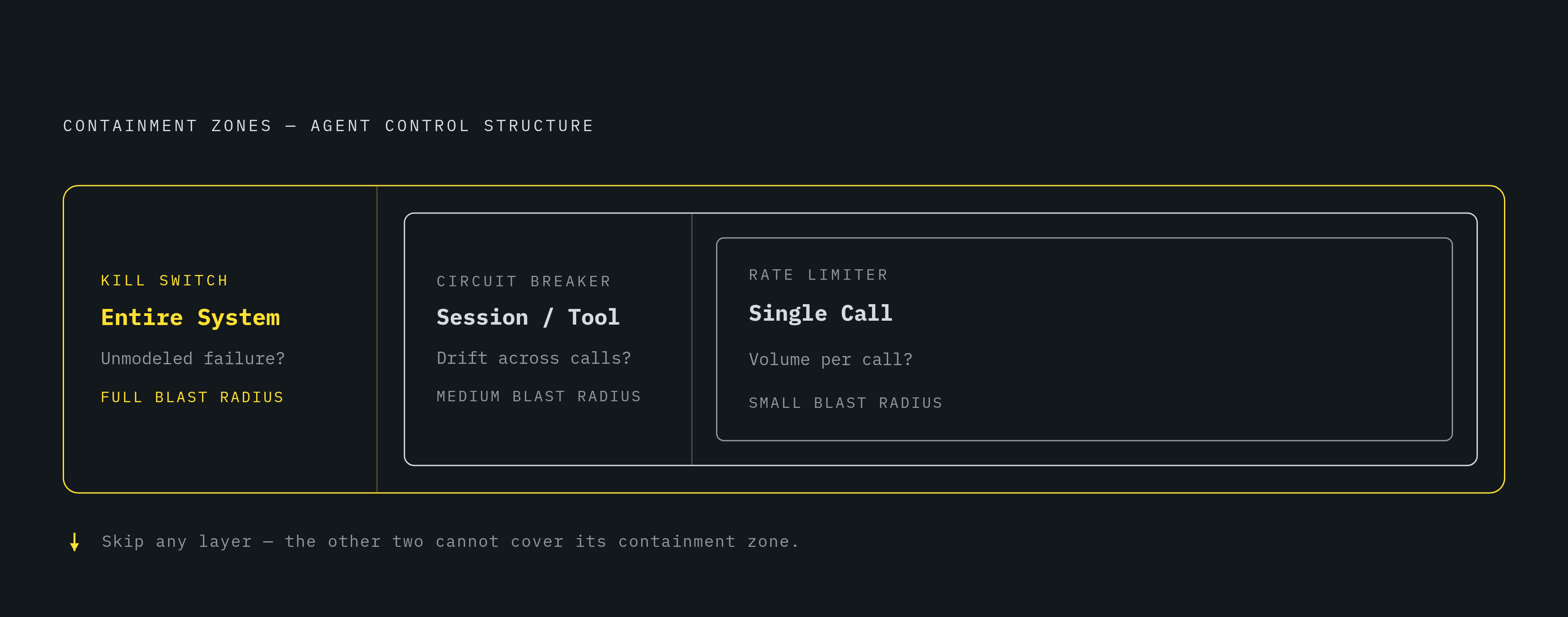
None of this works as a single mechanism, and treating any two of these three controls as redundant is the mistake that leaves a gap. Production agent systems need all three, because each one answers a different question about a different kind of failure.
A rate limiter keeps any single action small, bounding volume per call or per minute before a bad pattern accumulates into a real problem. A circuit breaker operates one level up, watching for drift across multiple calls, a pattern visible only when you look at the sequence rather than any one request in isolation. A kill switch exists for the failure mode nobody modeled, the case where the assumptions baked into the rate limiter and the breaker turn out to be wrong. It's a hard stop, and it doesn't try to be clever about it.
These map directly onto blast radius. A rate limit contains damage to a small radius, roughly one call at a time. A circuit breaker contains damage to a medium radius, a session or a single tool. A kill switch halts the entire system. Skipping any one of the three leaves a gap the other two were never built to cover.
Auto-close is the one place agent systems have to break from classical circuit breaker orthodoxy, and copying the microservices pattern wholesale here would be a real mistake, not a minor stylistic choice. In a distributed system, guessing wrong about recovery costs a handful of additional failed calls, so letting the breaker auto-close after a cooldown timer is a reasonable trade. An agent acting in the real world doesn't get that same cheap failure mode: resuming into a problem that hasn't actually been fixed can mean an irreversible action gets taken, not just another failed HTTP request. So the rule for agents has to differ from the textbook version. An open breaker does not auto-close on a timer. Resuming is a deliberate, logged decision a human makes, not something the system decides on its own because sixty seconds passed. HALF-OPEN still exists, but it becomes a tool a human uses to confirm a fix under a tight cap.
Different teams building this pattern independently is what makes it a real problem rather than a fad. Projects with names like AgentCircuit, AgentFuse, FailWatch, and Runtime Fence have each been built separately, generally by a developer who had already lived through something like the eight-hour retry loop described earlier. The pattern converges every time. The tooling hasn't standardized yet, and that gap is worth watching.
Observability requirements that make circuit breakers actionable in production
A circuit breaker that trips silently is barely better than no circuit breaker. Someone still has to find out it fired, understand why, and decide what happens next. Getting a breaker to actually change behavior in production, rather than producing a log line nobody reads until the postmortem, means treating every trip as an event with its own record: which tool, which failure signal crossed which threshold, what the state transition looked like, and what the cooldown or escalation path did afterward.
That record has to separate the two jobs a breaker does, resilience and governance, because a tripped rate limiter and a blocked unauthorized action call for different responses and different people looking at them. A rate limit tripping is an engineering event. A scope violation tripping is a security event, and it belongs on a different desk. Because the agent-native rule against auto-close puts a human in the loop for every reopen, the trip has to surface somewhere a person will actually see it, such as an alert, a queue, or a dashboard, something with a clock attached to it rather than a line in a file nobody tails.
A breaker that opens correctly but reports only to a log file nobody reads accomplishes nothing beyond what the original overnight bill already proved on its own. Detecting the failure was never the hard part of this problem. Whether anything acts on that detection before the damage lands decides if the breaker was worth building.
Sources
- Designing Fault-Tolerant Autonomous AI Agents: Circuit Breakers, Retry Policies, and Observability
- Capsule Launches AI Circuit Breaker to Block Rogue Agents
- AI Agent Circuit Breakers: The Pattern Teams Need [2026]
- AI Agent Circuit Breaker Pattern: Stop Cascading Tool Failures (2026) | Cordum
- Applying Site Reliability Engineering to Autonomous AI Agents | Microsoft Community Hub
- Resilience Circuit Breakers for Agentic AI | Medium
- AI Agent Circuit Breakers: The Reliability Pattern Production Teams Are Missing
- dev.to