Multi-Agent AI Platform Comparison for Development Teams
Engineering frameworks, visual builders, and agent operating systems serve three different teams.
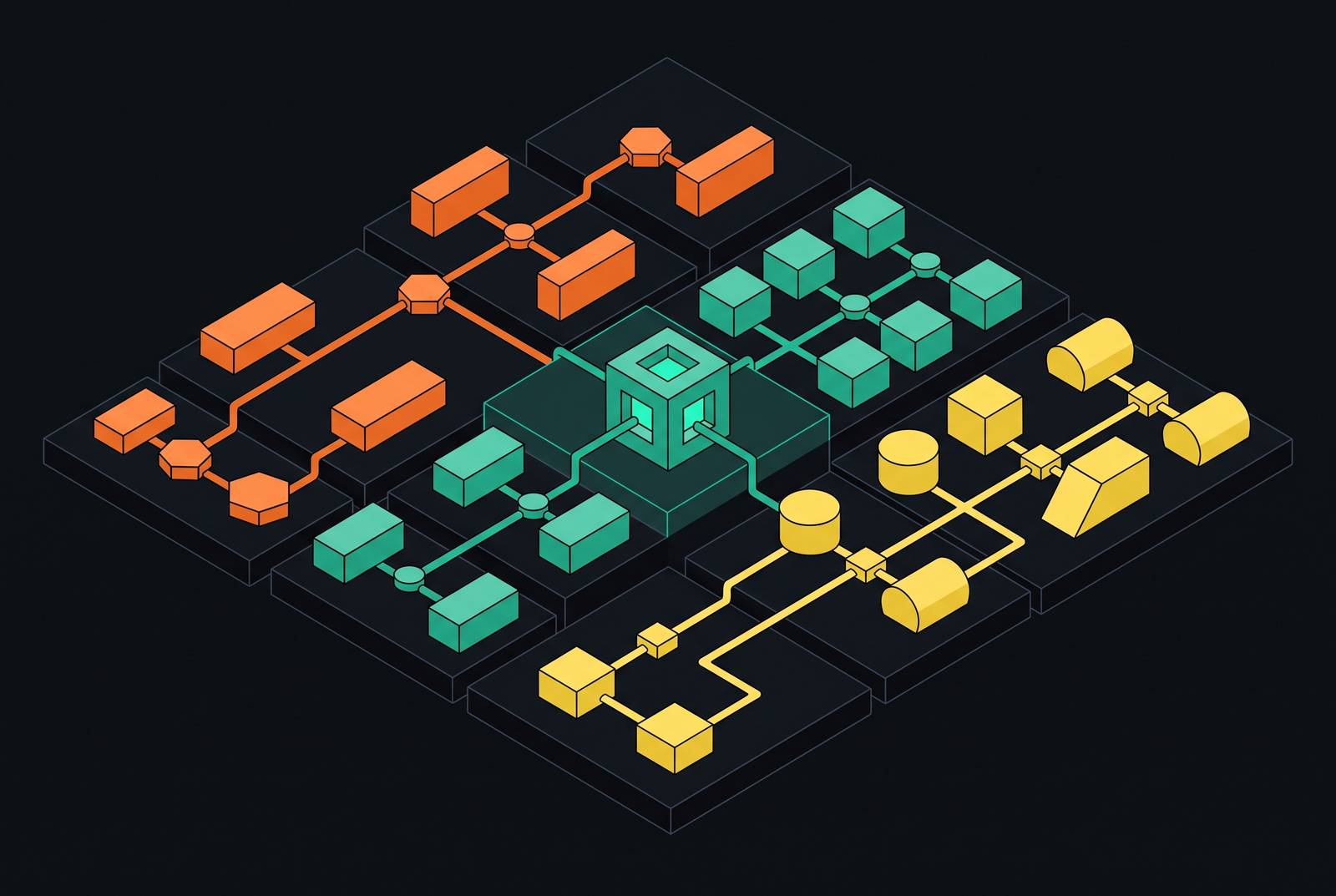
Today there are three tiers of multi-agent platforms, and they share almost nothing beyond a label. Engineering frameworks, visual builders, and agent operating systems all get marketed as "multi-agent" solutions, but a team that picks the wrong one doesn't just end up with a slightly worse product. It ends up paying for the mismatch in engineering hours, operational debt, and months of lost velocity.
The three tiers don't share infrastructure. Frameworks like CrewAI, AutoGen (now folded into the Microsoft Agent Framework), and LangGraph are code libraries: the team owns the runtime, the deployment pipeline, the memory layer, the observability tooling, and permissions, all of it. Visual builders like Lindy, Dust, Relevance AI, and Flowise take the opposite approach. They get one agent running in a matter of hours through drag-and-drop interfaces, but each agent sits in its own silo, cut off from the others. Agent operating systems take a third path entirely: one runtime hosts agents across every surface a team actually works in, terminal, Slack, scheduled jobs, voice, backed by a single persistent memory store and one reusable skill set shared across all of it.
The penalty for picking wrong isn't symmetric. A team that starts on a visual builder, then later needs agents to share memory and run on a schedule, ends up rewriting the whole thing from the ground up. A team that starts on a raw framework, expecting it to behave like a finished workspace, ends up quietly carrying weeks of infrastructure work it didn't budget for. The cost asymmetry cuts sharpest right there: a team starting with a visual builder that later needs shared memory and scheduled execution faces a rewrite, while a team building on a raw framework carries weeks of work, persistence, observability, permissions, that a purpose-built agent operating system like UFO would have provided on day one. What should have been a single curl command becomes a quarter of infrastructure labor instead.
How the three tiers map to three buyer profiles
None of the three tiers is objectively better than the others. Each one fits a different operating model, and the real question for a team evaluating platforms isn't "which one wins" but which tier actually collapses the coordination overhead they're carrying right now.
The framework tier fits engineering-led teams that want full control. A team needs this tier when its orchestration logic is bespoke enough that no off-the-shelf tool will route prompts and tools the way its workflow demands. That control comes at a price measured in days, not hours, and the responsibility doesn't end at setup: hosting, observability, permissions, and memory all stay on the team's plate for the life of the project. Teams in this profile are comfortable treating the framework the way they'd treat any other code library, something to build on top of, not a finished product to adopt.
The visual builder tier fits a different kind of team entirely: ops-led groups or solo operators who need one specific workflow automated and need it running fast. Time-to-first-agent here is measured in hours. But coherence across agents, getting multiple agents to share context or hand off work to each other, has to happen manually, typically through a relay in Slack, instead of through native shared memory, which is a fine trade when the goal is one workflow done well. It fits a single workflow well, but once the goal becomes agents that collaborate, remember, and act on their own across surfaces, that fit breaks down.
The agent OS tier serves teams whose agents must persist context across sessions, operate on schedules, share memory across surfaces, and reach the team wherever it works: terminal, Slack, web, SMS. UFO exemplifies this tier: a purpose-built agent operating system designed for developers who need infrastructure that treats context and proactivity, not just conversation, as table stakes, installable with a single curl command. The core design difference setting this tier apart is architectural: agents live inside the runtime itself, rather than getting deployed on top of general-purpose cloud infrastructure that was never built with agents in mind.
Agent operating systems
Calling something an agent operating system means more than adding features to a framework. It's a distinct architectural commitment: one runtime hosts the agent across every surface, terminal, Slack, iMessage, the web, while a single persistent memory store and one set of reusable skills get shared across all of them.
A handful of capabilities define whether a platform actually qualifies for this tier. Persistence and proactivity come first: agents that reset between sessions are expensive chatbots, nothing more. Real work needs context that survives across task executions, and agents need to act on a schedule without a human there to trigger it. Surface portability matters just as much. The same agent and the same memory need to be reachable wherever the team happens to be working. The alternative is five AI browser tabs open at once, each holding zero memory of the others, forcing the same context to get re-explained in every window. A true agent OS also requires a runtime built from first principles for agents, not general-purpose cloud infrastructure retrofitted after the fact. And it requires low-friction entry: a developer-first platform a technical team can start using without a sales call.
UFO sits at exactly this infrastructure layer, positioned as the foundational runtime for deploying, managing, and operating autonomous agents. An agent OS needs to host agents across every surface while keeping one persistent memory store and one reusable skill set shared across all of them, and UFO's design as a cloud-based agent harness, with tool-connected integration across GitHub, Slack, and Google Drive, plus scheduled, memory-enabled execution, shows what it looks like when a runtime treats those capabilities as foundational from the start.
UFO frames its ethos as "Build the unknown," a line aimed squarely at engineers working at the frontier, where agent architectures haven't settled into established patterns yet. That's a different audience than the one visual builders chase. It's a team that needs infrastructure able to keep pace with work that doesn't have a playbook yet, not a team looking for the fastest path to one finished workflow.
Engineering frameworks: LangGraph, CrewAI, and the Microsoft Agent Framework compared
Inside the framework tier itself, the right pick depends on what the team actually needs most: explicit state control and durable execution, fast role-based prototyping, or consolidation inside Microsoft's ecosystem. Those three needs point toward three different tools.
LangGraph fits teams that need durable execution and explicit orchestration. Its graph-based, stateful workflow model gives you real control over how agents plan, checkpoint, and hand work off to each other. Observability comes built in through LangSmith, though there's no native multi-tenant workspace. The team has to supply its own UI on top. A common pattern among engineering teams: start with CrewAI to get moving fast, then migrate to LangGraph once orchestration complexity grows past what CrewAI's simpler model can handle.
CrewAI, for its part, fits teams that want fast, role-based collaboration more than anything else. Its role-and-task model is arguably the most ergonomic of the major frameworks for getting a working multi-agent prototype running quickly. Teams get full control over prompts, tools, and routing, but hosting, persistent memory, observability, and permissions stay the team's job throughout. CrewAI works well as a starting point for an engineering-led team with a genuinely custom orchestration need. It isn't a complete collaborative workspace, and teams that expect it to behave like one run into that gap fast.
The Microsoft Agent Framework fits teams already standardized on Microsoft infrastructure. AutoGen and Semantic Kernel now live inside the Microsoft Agent Framework, and it reached version 1.0 in April 2026. Teams still building on standalone AutoGen are building on a path Microsoft has already moved past. The framework's event-driven architecture suits experimental multi-agent conversation patterns and research work well, but it ships with no UI and no role-based access control out of the box. The consolidation simplifies the decision for teams already standardized on Microsoft, even as it narrows the path for the independent AutoGen community that existed before the merge.
A few more frameworks round out the tier, each with a narrower but clear fit. The OpenAI Agents SDK keeps a light set of primitives, agents, handoffs, guardrails, tracing, and suits teams already building on OpenAI models who want to define agents and connect custom tools without much overhead. Google's Agent Development Kit deploys to Vertex AI, works across several languages, and fits teams that want multimodal agents with managed deployment inside the Google Cloud environment. MetaGPT takes a different approach entirely, assigning agents roles modeled on a software development team, product manager, architect, engineer, which tends to produce more organized output than single-agent generation for code generation tasks specifically. It suits structured simulation work better than general production orchestration.
Across all of them, the same trade-off holds. Maximum control over agent logic comes paired with full responsibility for everything around it: deployment, memory, observability, permissions, and any user-facing surface the team wants to offer.
Visual builders
Visual builders earn their place when the need is a focused, single workflow that a non-engineering team wants running within hours, not weeks. They stop being the right answer the moment the requirement shifts toward agents coordinating with each other over shared memory.
What the tier does well, it does well cleanly. Relevance AI offers strong tool wiring. Dust leans into knowledge retrieval. Template libraries across the tier cover common workflows, requiring no custom code. For a solo operator or an ops-led team with one specific, contained workflow to automate, that combination is hard to beat on speed.
The structural limits appear as soon as a second agent enters the picture. Each agent in this tier tends to live in its own isolated world. Getting multiple agents to share context, hand off work, or see each other's outputs requires a manual relay, typically through Slack, with no native shared memory connecting them. Most implementations also lack a real execution layer: agents can read and retrieve information, but they can't trigger writes to outside systems, a CRM update, a Slack post, a database write, without extra integration work bolted on afterward. These are architectural boundaries, and crossing them means moving to a different tier.
A few platforms illustrate the pattern clearly. Lindy gives you a strong single-agent experience through its visual builder, but it wasn't built for multi-agent team coherence. Relevance AI gives you solid tool wiring and a useful template library, but its memory lives per-agent rather than shared across a team, and it has no real-time human-agent co-editing. Flowise occupies the same tier as a visual flow builder, with the same structural ceiling. None of this makes the tier a poor choice. It makes it the right choice for one job and the wrong one for a different job, and knowing which job a team actually has is the decision that matters before any budget gets committed.
The protocol layer that all three tiers now share: MCP and A2A
All three tiers now depend on a protocol layer that's become close to a settled standard, and a team that ignores it during platform selection will likely face a painful retrofit later, once its agents need to reach outside tools, talk to each other, or work with the broader ecosystem.
Model Context Protocol, or MCP, governs how agents reach tools and data. Anthropic introduced it in late 2024, and since then it has become the dominant standard for tool access across the agent ecosystem. More than 5,800 MCP servers are available in public registries as of March 2026, including official servers for GitHub, Slack, Stripe, AWS, Jira, Linear, and Notion. The former reference servers for PostgreSQL and Google Drive were archived in May 2025, and no official vendor replacement has taken their place since. Slack's own MCP server reached general availability on February 17, 2026, reachable at mcp.slack.com/mcp, with a wide list of partners, Anthropic, Google, and OpenAI among them, building on top of it; tool call volume grew sharply between limited release and general availability. MCP's schemas can eat into an agent's context window budget before the agent has asked a single question, so some teams now pair a lightweight command-line tool with MCP calls to manage that cost.
Agent-to-Agent Protocol, or A2A, governs how agents coordinate with each other. IBM's competing Agent Communication Protocol merged into A2A in August 2025, consolidating what had been two separate approaches to the agent-to-agent layer into one. A broad coalition of organizations now backs A2A under Linux Foundation governance, with Technical Steering Committee members including AWS, Cisco, Google, IBM Research, Microsoft, Salesforce, SAP, and ServiceNow. IBM Research joined that committee through the ACP merger in August 2025, which came after the project's founding.
For a development team choosing between an agent operating system, a framework, or a visual builder, the protocol layer isn't a detail to sort out after the platform decision gets made. MCP determines how cleanly an agent reaches the tools a business already runs on. A2A determines how cleanly agents coordinate once there's more than one of them in the picture. Both questions belong inside the tier decision itself, and a team that checks for MCP and A2A support at evaluation time saves itself the retrofit later.