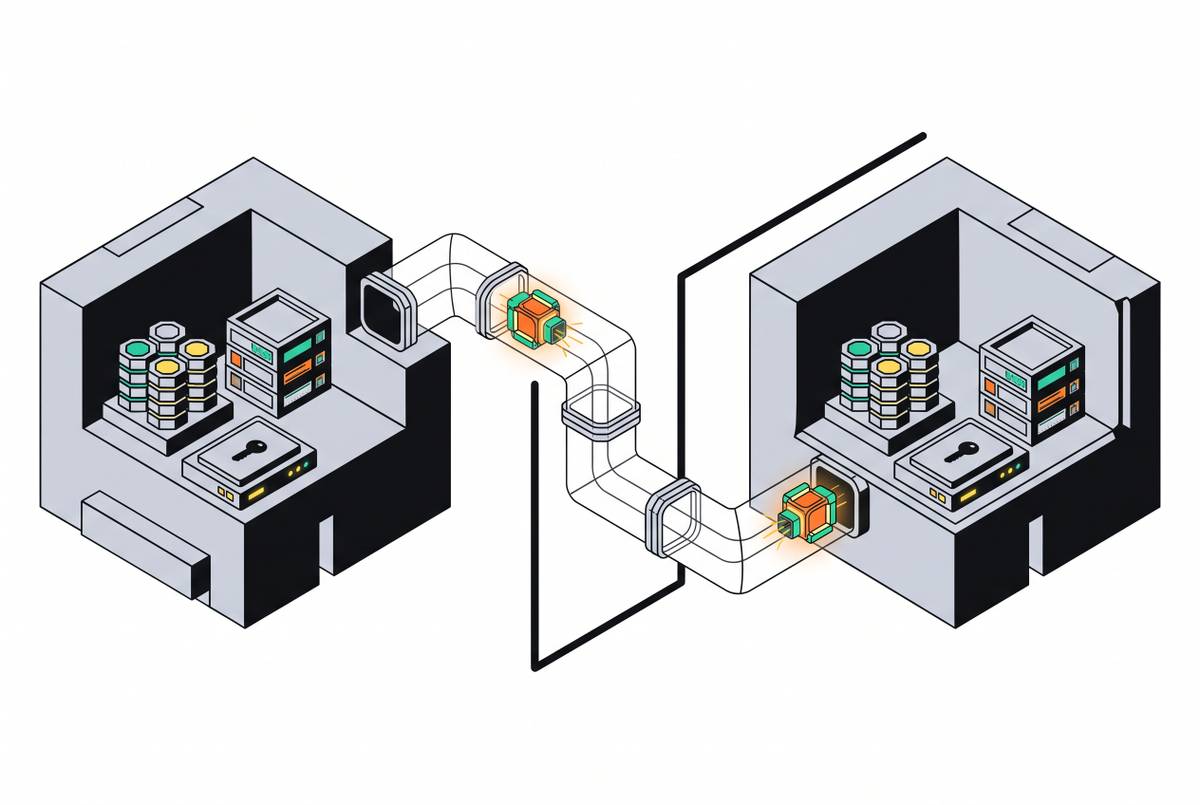
Context Window Management as a Runtime Concern
Runtime layers need to actively govern context windows like managed resources, not passive buffers.
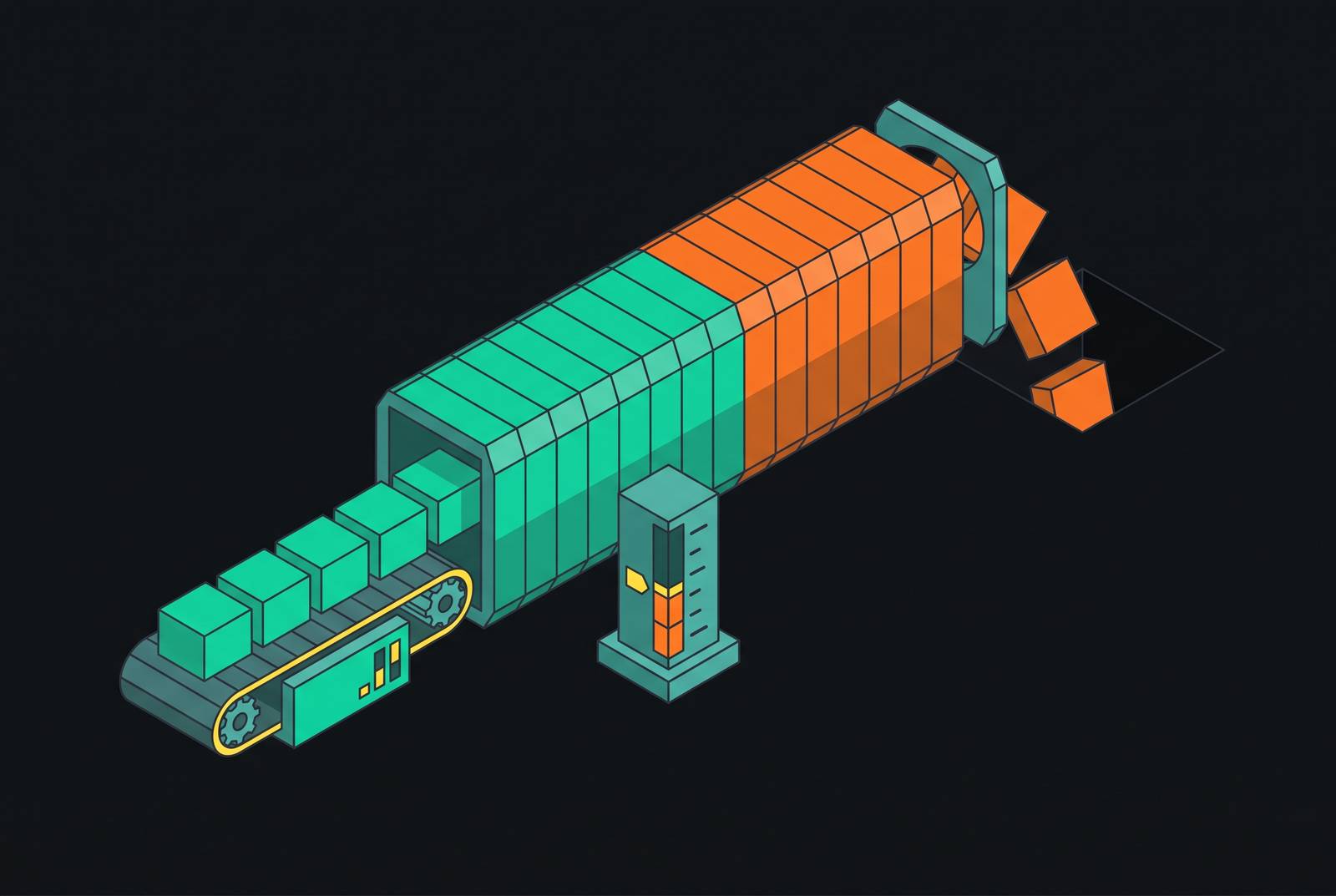
Context window management belongs in the runtime layer: not in prompt text, and not in application code. The window itself is a bounded, contested resource, and it needs active governance every session, every call, every agent. That's the claim this piece makes, and the rest of it is about what that governance actually looks like when it's built right versus bolted on.
Context windows as managed resources, not passive buffers
A context window is the entire reasoning workspace for one inference call, and six different categories of content are fighting for space inside it at the same time: system instructions, the current goal, conversation history, retrieved knowledge, tool definitions and schemas, and execution state. None of these categories gets priority by default. They compete for the same fixed budget, and every token spent on one is a token unavailable to the others.
The cleanest way to think about a context window is as inference-time RAM. And it clears completely the moment the call ends. Nothing survives from one inference to the next unless some external system deliberately carries it forward. A product marketing manager at a vendor in the space puts it directly: "Every token wasted on low-signal content is a token your agent can't use to reason. That's the entire economics of the problem in one sentence. Space spent on noise is space taken from signal.
Long-horizon tasks make this worse by default, not by accident. Every tool call result, every intermediate reasoning step, and every document an agent pulls in: all of it gets added to the running trajectory. The trajectory grows roughly linearly with the number of steps taken, so the window fills with accumulated exhaust long before anyone hits a hard token ceiling.
The natural response is to reach for a bigger window. But that's treating a symptom as if it were the disease. Production agents don't usually fail because they run out of space. A bigger window doesn't cure context rot; it just gives the rot more square footage to spread across.
Enterprise environments show a particular flavor of this. None of that gets fixed by writing a cleverer prompt. Window size and context quality are separate problems. Even at the largest token limits available today, what gets loaded into the window shapes whether the agent reasons correctly or confidently produces nonsense.
Context decay in unmanaged long sessions
Without some explicit mechanism deciding what stays and what goes, long sessions degrade in ways that are both predictable and compounding. Passing an orchestrator's full context down to every sub-agent compounds irrelevance instead of containing it, because now every sub-agent is carrying baggage that has nothing to do with its actual job.
Hard rules set early in a conversation tend to erode quietly as the session goes on. The agent simply stops honoring a rule it technically still has access to, and nobody notices until the output looks wrong. That drift is one of the primary mechanical sources of agent unreliability over long sessions, and it has nothing to do with the model getting "confused" in some vague sense. It's a structural consequence of where a token happens to sit.
A separate and equally common mistake is treating the context window and the context store as if they were the same thing, or as if they were interchangeable choices. Confusing these two is a common reason enterprise agents fail once they're running at real scale, because fixing context rot usually requires a better store feeding the window in the first place, not a smarter prompt.
Context store architecture splits into four distinct tiers, and you need a different one depending on what you're retrieving. Vector databases like Pinecone, Weaviate, and Qdrant handle semantic retrieval, pulling back content by meaning rather than exact match. Knowledge graphs, Neo4j being the named example, handle multi-hop reasoning across connected entities, where an answer needs you to follow a chain of relationships rather than a single lookup.
Context window management is fundamentally a runtime responsibility. The agent operating system layer has to enforce policies for what enters, persists, and exits the window consistently, across every session and every agent running on it. Platforms like UFO, built specifically as agent operating systems, treat context governance as core infrastructure, not something you leave to application code or prompt engineering workarounds layered on afterward.
Multi-agent systems bring in a second failure mode, and it's qualitatively different from single-agent drift. If you give every agent too little shared state, their reasoning disconnects, and each one works from a different picture of what's actually happening. But if you give every agent too much shared state, they start reinforcing each other's assumptions instead of checking them, a kind of confirmation bias baked into the architecture itself. The right answer sits in between: a narrow, tailored view of investigation state built around what each agent's specific role actually requires. Each one needs its own slice, shaped to its job.
The five strategies teams use today
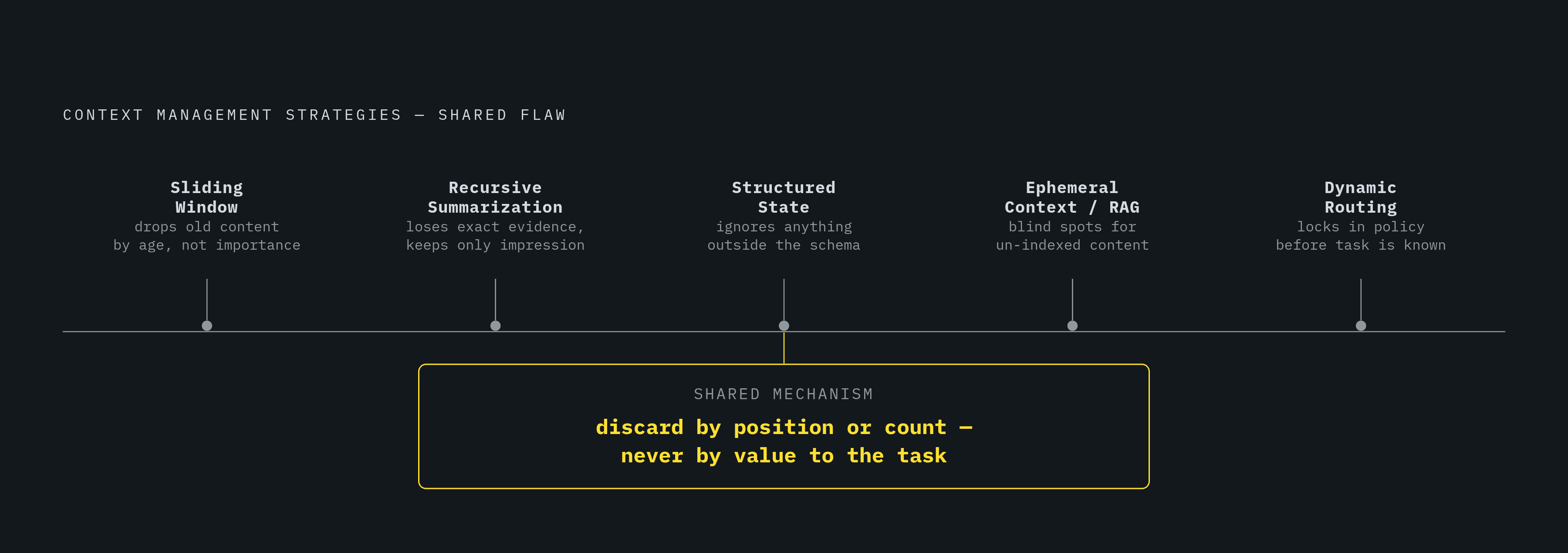
Five strategies dominate how teams currently manage context, and all five share the same underlying mechanism: they fire based on token count or position, not on whether the content actually matters to the task still in progress.
Sliding windows drop the oldest messages to make room for new ones. Simple to implement, and reliably wrong in one specific way: an early decision or constraint the agent still needs can get discarded purely because of when it was said, even though it hasn't stopped mattering. An agent can end up looping on a problem it already solved, because the solution scrolled out of the window.
Recursive summarization compresses older messages into a running summary instead of deleting them. This keeps the general shape of a long task intact, the mission and the plot, so to speak, but it loses fine detail in the process. The agent ends up with a vague sense of its own history instead of exact evidence it can point back to, and long-horizon tasks often need that exact evidence, not an impression of it.
Structured state management replaces the running chat transcript with a tracked scratchpad, usually JSON, holding goals, facts, and errors in a defined schema. It's efficient on tokens, but brittle in exactly the way you'd expect from anything schema-bound: when something unexpected doesn't fit the predefined fields, the agent just ignores it.
Ephemeral context through retrieval-augmented generation offloads accumulated context to an external vector database and pulls pieces back in when you need them. It solves overflow cleanly, and it creates retrieval blind spots in exchange: anything that was never indexed, or indexed poorly, simply doesn't come back when it's needed.
Dynamic context routing sits above the other four, using a controller to pick a strategy once some growth threshold gets crossed. It narrows the failure surface somewhat, but it still locks in a fixed routing policy before anyone knows what the task will actually require later on.
What do all five have in common? Each one discards or compresses tokens based on position or count, never based on value to the task still unfolding. Any detail that didn't survive the compression is gone for practical purposes, even if the raw log technically exists somewhere else.
This matters most on long-horizon tasks, where the agent might need exact historical evidence, or might need to compute something over two events that happened far apart in the trajectory. When the context gets compressed, you don't yet know the specific information needed or the operation required. No summary written at observation time can guarantee it kept what turns out to matter three hundred steps later.
There's a second failure specific to pruning and eviction approaches, one that's easy to miss because it appears as a performance problem rather than a correctness problem. Unconstrained changes to the token sequence alter the layout of the prompt, which breaks prefix matching and invalidates the prompt cache. That tradeoff, between keeping the text sparse and keeping the cache coherent, isn't solved by any of the five strategies working alone.
Recent research reframes context management as a runtime policy problem
The research frontier in 2026 takes a different approach from all five practitioner strategies at once. Instead of a static rule baked into the harness, the systems coming out of this work use a learned policy that decides, turn by turn, what gets kept, what gets dropped, and what gets compressed. Agents running on these policies outperform agents running on fixed heuristics, which is the whole point of treating context management as a runtime decision instead of a design-time one.
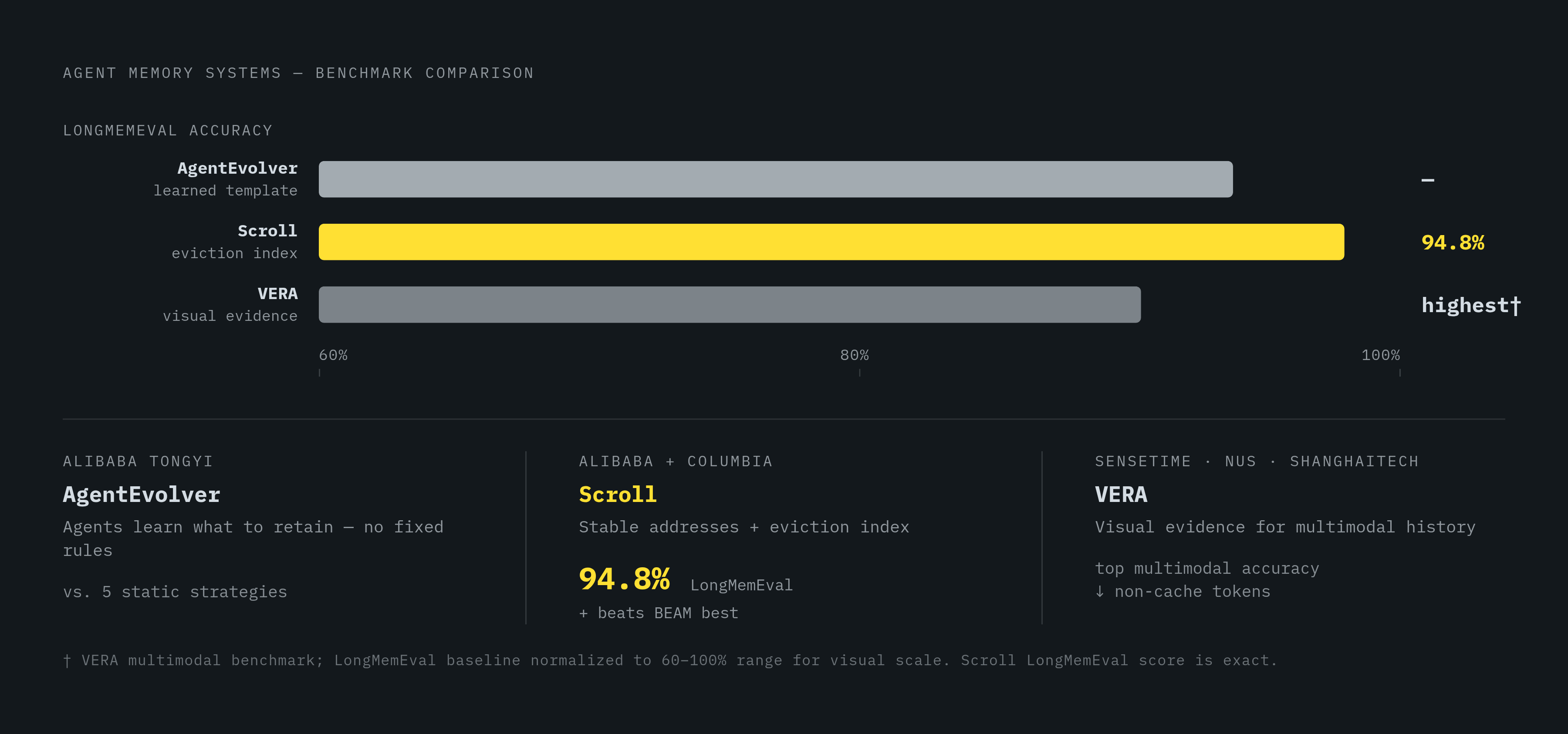
AgentEvolver, from Alibaba's Tongyi Lab, gives the agent a template for managing its own context. In plain terms, the agent learns over time what it's actually going to need later, rather than following a fixed rule about what to discard.
Scroll, the joint Alibaba and Columbia project, takes a more structural route. When the working view gets close to its budget, older spans get evicted from that view, but they're recoverable through an eviction index tied to stable addresses in the Event Log. Eviction changes what the model currently sees. It never touches the underlying record. On benchmark results, Scroll reaches 94.8% on LongMemEval, beats the best published memory system on BEAM, and exceeds the best published long-horizon agent by a wide margin on long-horizon agent benchmarks.
VERA, built by researchers at SenseTime, NUS, and ShanghaiTech, tackles a different angle on the same problem: what happens when agent history isn't just text. VERA introduces a Visual Evidence-Retaining strategy, built on top of Visual Rendering, so it can manage context for multimodal histories. On text-heavy benchmarks, it renders textual history as visual memory. VERA substantially cuts cumulative non-cache tokens compared to running with no compression at all, and it posts the highest accuracy among all baselines tested on multimodal tasks.
What ties these three systems together is a shared principle: each one separates the question of what history to retain from the question of how that history gets represented and accessed, and each one makes that call at runtime instead of locking it in at design time. Static content, like system instructions, gets anchored at the front of the prompt, and dynamic content gets injected last, which keeps prompt caching intact, a structural ordering choice that the five practitioner strategies routinely violate without realizing it.
Should context management live in the serving layer, where the infrastructure running the model handles it as KV-cache scheduling? Or should it live in the application and agent layer, as self-management the agent itself performs? Both Scroll and AgentEvolver come down on the side of the agent layer, giving the agent itself the responsibility for managing its own history rather than leaving it to the serving infrastructure underneath.
Runtime context management in production deployments at scale
Production systems running long-horizon agents today have converged on roughly the same architectural answer the research points toward: context has to be managed by a persistent, session-aware layer sitting underneath the agent, assembled by that layer instead of by application code on every call.
Slack runs its internal security investigation service as teams of AI agents who work together on security investigations. Each individual AppAgent maintains two layers of state: a private log of every action it took, every control decision, every chain-of-thought trace, and a shared layer made up of updates to a system-wide blackboard holding intermediate outputs, errors encountered, and application-level insights. That architecture is a direct answer to the coherence-versus-bias tradeoff described earlier: instead of giving every agent full access to everything, it gives each one a tailored slice built around its specific role.
Red Hat's multichannel agent takes on a related but distinct problem. One active session spans Slack, email, web, CLI, and webhooks simultaneously. Cross-channel continuity becomes a property of how sessions are built at the runtime layer.
AIOS, out of Rutgers University, makes the runtime argument most explicit by framing itself as the first LLM agent operating system. It introduces a kernel built specifically for LLM agents, where context management sits as one of several co-equal services alongside agent scheduling, memory and storage management, tool management, and access control. Its context manager handles task interruption and resumption through snapshot and restoration, and it preserves intermediate state using both text-based and logits-based methods, so if a long-running task gets interrupted partway through, it can pick back up without losing its place.
The conflation of context window and context store is exactly the structural failure that agent infrastructure needs to prevent. The window resets after every single inference call. The store persists across sessions and should be the thing intelligently populating what enters the window. An agent operating system that treats persistence and proactive context management as first-class primitives, rather than something stacked on top of generic cloud tooling after the fact, can enforce that separation along with the retrieval policies that govern it.
Incident response makes the stakes of all this concrete in a way that's hard to argue with. Whether an agent retains its investigation trace across the remediation step is the specific technical bottleneck for reaching the highest levels of autonomous response. Without a persistent session layer carrying that trace forward, the remediation step starts blind, working from nothing, regardless of how sophisticated the investigation that came before it happened to be. Managing the right granular view of state for each agent's role isn't a detail to patch in later. It requires infrastructure built from the start to treat agents as first-class citizens, something a workspace-based agent platform can coordinate across an entire team rather than leaving every application to solve on its own.
Sources
- When History Is Multimodal: Rethinking Context Management for Long-Horizon Agents
- Context as an Environment: Programmatic Context Management for Long-Horizon Agents
- TokenPilot: Cache-Efficient Context Management for LLM Agents
- How to Manage AI Agent Context Windows
- LLM Agents Are Latent Context Managers: Eliciting Self-Managed Context via State Proprioception
- Towards an Agent Operating System - Lessons from Classical and Cloud OS
- UFO — Build the unknown.
- Agent libOS: A Runtime Substrate for Capability-Controlled Self-Evolving LLM Agents