Stateless vs. Stateful Agent Runtime Tradeoffs
Choosing stateless or stateful architecture sets a hard ceiling on what agents can accomplish.
Stateless vs. Stateful Agent Runtime Tradeoffs.
Why the stateless/stateful choice is an architectural ceiling, not a storage preference
Whether an agent runtime holds onto state or throws it away sets a hard ceiling on what the agent can actually do, and getting it wrong doesn't just cost efficiency, it caps capability before a single prompt gets written. Most LLM APIs, GPT-4, Claude, Llama, are stateless by default: they remember nothing between calls unless the caller explicitly re-sends the context. That "chat memory" feature in most SDKs? It's not the model remembering anything. It's client-side code quietly resending the whole conversation with every new request.
The real architectural question is where memory lives between requests, and whose job it is to manage that. That question drives every scaling decision, every failure mode, and every dollar spent on token usage. According to a 2026 State of Agent Engineering report, 57% of organizations now have agents running in production, up from 51% the year before, and output quality has overtaken cost as the top barrier to scaling further, cited by 32% of respondents LangChain's 2026 State of Agent Engineering report. A meaningful chunk of that quality problem traces straight back to state. An agent that loses context mid-task, or can't recover cleanly after a crash, isn't something anyone hands the keys to for unsupervised work.
Picking between the two is a decision with real consequences, unlike choosing a database engine and shrugging. It's the decision that determines the upper bound on what an agent can accomplish for a given workload. Get the tradeoff surface, scaling behavior, failure modes, persistence guarantees, and the hybrid pattern that blends both, and you can make this call on purpose. Skip that homework, and you make it by accident, usually around the third production incident.
Where stateless agents belong
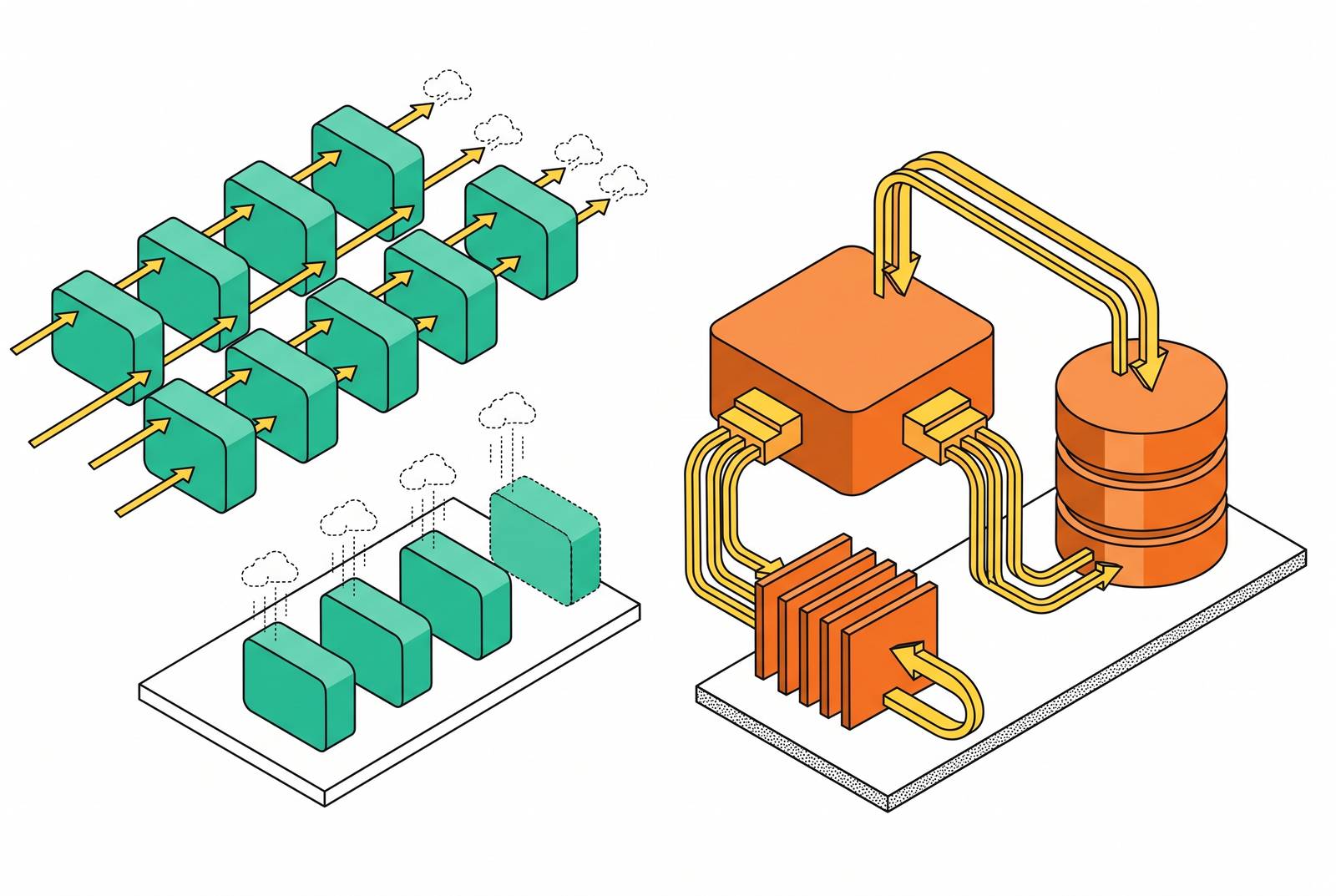
Strip a stateless agent down to its mechanics and there isn't much there: receive input, build a prompt, call the model, return the output. Nothing gets saved. Every interaction starts from zero, like the agent just woke up with no memory of yesterday, because in a sense, it did. There's no session lookup, no database round-trip, no persisted anything. Whatever context the agent needs has to be stuffed into the prompt by whoever's calling it.
That sounds limiting, and in a lot of ways it is. But limitation isn't the same as weakness. Stateless agents scale horizontally without any real coordination, since any instance can handle any request and nobody needs to remember which server talked to which user last time. They fit zero-retention compliance work well too, cases where forgetting isn't a bug, it's the entire point. They're reproducible and cacheable in a way stateful systems struggle to match, which is why benchmarks like SWE-bench and AgentBench run agents statelessly during evaluation. And they're a natural fit for atomic, high-throughput tasks: classification, extraction, single-turn Q&A, explaining a chunk of code.
But push a stateless agent into anything multi-turn and the cracks show fast. Picture this: tell a stateless agent your name on turn one. Ask it "what's my name?" on turn two, with no client-side history replay. It has no answer, because the information was never retained in the first place, full stop. Multi-turn conversations force the frontend to re-send the entire conversation history with every single request, and that history keeps growing, snowballing token usage turn after turn. A stateless agent can't finish a multi-step task on its own, can't recover if it crashes halfway through a workflow, and can't produce any real audit trail of what it did. Worse, put two stateless agents on the same problem and there's no shared source of truth between them, so instead of collaboration you get race conditions.
None of that makes stateless agents a lesser design. It makes them the right tool for a specific, bounded slice of work, and a poor fit for nearly everything outside that slice.
What stateful agents carry and its persistence costs
A stateful agent works differently at the core. It loads prior state keyed to something like a user ID, session ID, or workflow ID, uses that state to shape its current response, then writes an updated version back for next time. Simple pattern, but the details of what gets carried affect performance and reliability far beyond what "conversation history" implies.
State here usually covers conversation memory (message history, preferences, past decisions), task checkpoints marking exactly which step a workflow stopped on, and tool outputs, meaning results from API calls, searches, or computations that don't need to be re-run every time, which matters a lot when those calls are expensive or rate-limited. It also covers files and generated artifacts that span sessions, plus environment metadata like which model version handled a given step. One underrated payoff: because the agent itself owns the history, the client payload stays small on every turn. The server can trim or summarize the conversation instead of resending the whole thing as it balloons.
That's real value for long-running assistants, coding agents tracking a repository across hours, customer service bots juggling multi-turn conversations, and research agents piecing together findings across stages. But none of it is free. Stateful design means schema design, serialization, and consistency handling, problems stateless agents simply never encounter. It often needs sticky sessions or partitioned stores just to route requests correctly. And every external state store is one more place where state can quietly drift out of sync with reality.
There's a security angle too, and it's not a small one. A 2026 Frontiers in Computer Science survey catalogs real incidents where persistent memory got exfiltrated through prompt injection, tool poisoning, or session hijacking. An agent that forgets everything the moment it's done simply has less surface area for an attacker to go after. Memory that persists is the very feature that makes stateful agents useful, and it is the same feature that gives attackers something to steal.
The amnesia tax: what misaligned training and runtime conditions cost in tokens
Here's a finding that deserves more attention than it's gotten. A preprint titled "Agents Learn Their Runtime: Interpreter Persistence as Training-Time Semantics" argues that interpreter persistence is baked into the training data itself, and it shapes how an agent learns to use an interpreter.
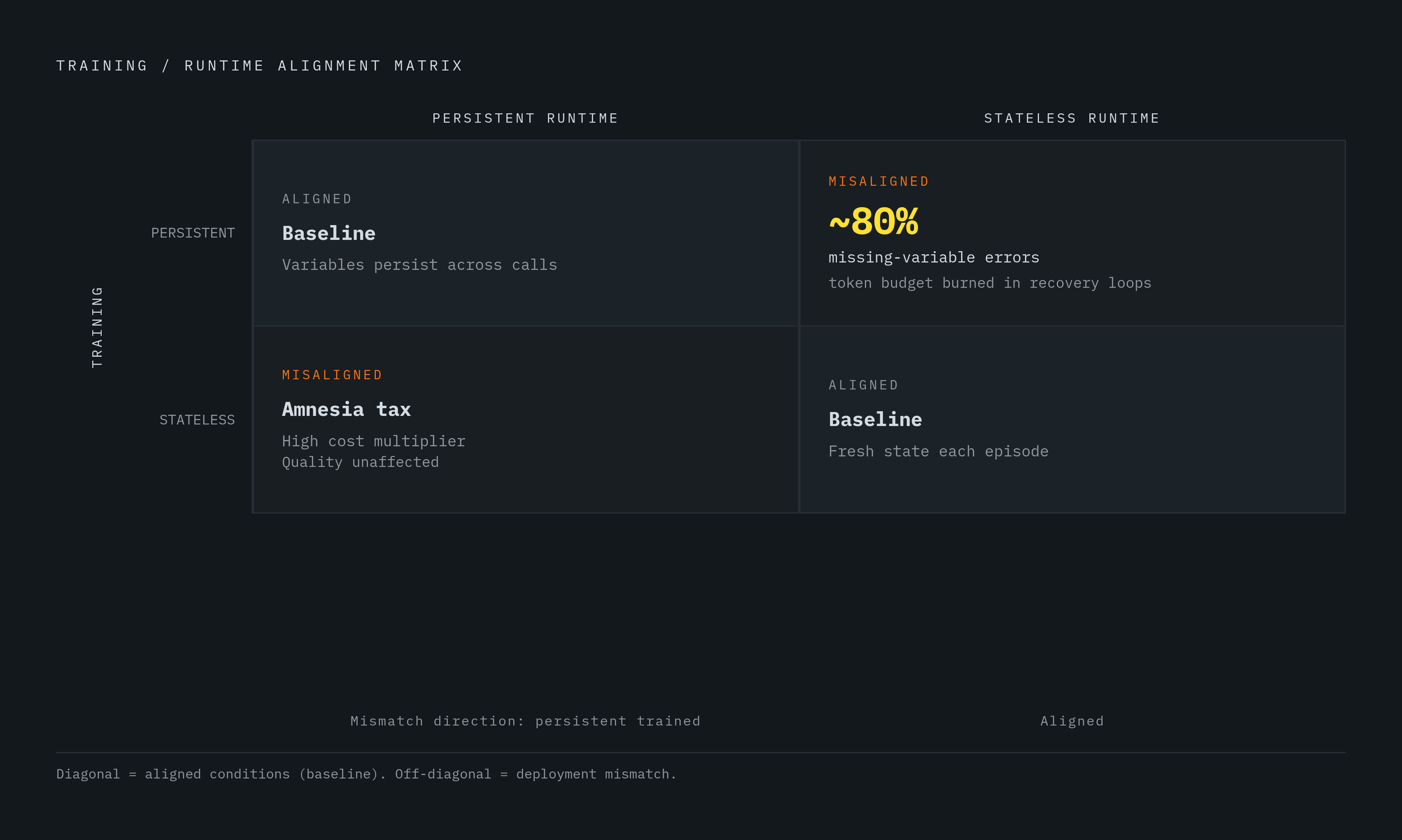
Training and runtime mismatches produced two failure patterns. Train on persistent traces, then deploy in a stateless runtime, and the agent hits missing-variable errors in roughly 80% of episodes, spiraling into recovery loops that burn through the token budget without making real progress Agents Learn Their Runtime. Flip it around: train on stateless traces, deploy in a persistent runtime, and the agent pays what the researchers call the amnesia tax.
What makes this worth remembering isn't just the multiplier, it's what didn't change. Solution quality wasn't meaningfully worse in the misaligned conditions arXiv:2603.01209. So the agent still got there, mostly. It just took a much more expensive, much less stable road to get there. That distinction matters: persistence shapes how an agent reaches an answer, not whether it reaches one.
The runtime used to generate fine-tuning traces needs to be a deliberate design choice, not an afterthought buried three layers down in the infrastructure. If misalignment costs this much even when the agent eventually succeeds, what happens when the runtime mismatch is bad enough that the agent fails completely? The 2×2 study crossed training conditions (fine-tuned on persistent vs. stateless traces) with runtime conditions (evaluated in persistent vs. stateless interpreter) on a controlled task family.
The five ways stateful agents break at scale
Production breakdowns in stateful agent systems tend to cluster around five recurring failure modes, according to a practical architecture guide from Tacnode.
Stale state from parallel overwrites is the first. Two agents, or two concurrent requests, touch the same state record at once, and without proper isolation one overwrite clobbers the other, leaving behind a record that's simply wrong. Partial updates are the second: a write sequence gets interrupted mid-flight, and the state store ends up holding a half-written record, which is exactly the kind of thing atomic write guarantees exist to prevent. Race conditions are the third, and they get worse as more agents join the picture. Multi-agent systems need a genuinely consistent shared view of state, or the agents stop collaborating and start fighting each other for the last word.
Prompt drift is the fourth failure mode, and it's the sneaky one. Accumulated state gets replayed into context in ways that gradually shift how the agent behaves, and it's hard to catch without tracing every state mutation against the model's actual outputs. Fifth: lost state across retries. A timeout or crash mid-workflow means starting over from scratch without durable checkpointing, which on a multi-hour research or remediation task costs real time and repeats model calls that were already expensive the first time.
There's a sixth pattern that disguises itself well, so it deserves its own name. Call it localized amnesia: session history gets stranded on whichever instance handled the earlier turns, and when a load balancer routes the next request somewhere else, the agent loses everything it had built up. It looks like a memory bug. It's actually a routing problem, and the fix is centralized caching, Redis being the common choice, or pinned sessions. One more lever gets left on the table too often: prefix caching. When a stable prompt prefix repeats across calls, caching it cuts both time-to-first-token and per-call cost, an advantage stateless designs lose entirely the moment they resend full context on every turn.
The advice that follows from all this is blunt but earned: decide the state paradigm before writing a single prompt template. Retrofitting session memory into a design that started stateless usually means rebuilding the orchestration layer from the ground up.
How the three-tier memory model structures what state goes where
By 2026, the engineering conversation had shifted LangChain's 2026 State of Agent Engineering report. Nobody serious was still asking whether to keep state. The real questions were how much, where, and at what cost. Treating all state as one undifferentiated blob is where a lot of teams get burned, because a user's name and a half-finished multi-step workflow don't belong in the same bucket, let alone the same latency profile.
Letta's three-tier model became the clearest way to think about this. Core memory sits always in context, functioning like RAM: editable blocks holding current task state and durable facts about the agent, the smallest footprint but the highest sensitivity to latency. Recall memory works more like a disk cache: searchable conversation history that gets pulled up on demand rather than sitting in context permanently. Archival memory is the cold storage layer, a long-term external vector store queried only through explicit tool calls, the lowest access frequency paired with the highest capacity.
A separate practitioner's guide pushes this to four tiers, splitting out semantic vector memory as its own layer distinct from episodic logs, covering in-context working memory, an external key-value store, episodic logs, and the semantic vector store. Other taxonomies map more to lifecycle than to access pattern: run or session state tied to one task and keyed by session ID, conversation state for message history within a single interaction, user state that persists across sessions, and long-term memory that accumulates over time and gets queried by similarity.
None of this matters without picking the right store for each tier. In-memory works fine for local testing. Redis handles low-latency shared session caching well. Anything meant to outlive a single run belongs in a durable database or vector store. State payloads should stay small and serializable, and transient properties need to stay separate from whatever actually gets synced and saved. Correlate LLM calls, tool calls, and state changes with persistent trace IDs from day one, so every mutation to state is observable after the fact.
The hybrid pattern: stateless model inside a stateful runtime
For most multi-turn, production-grade agent work, the recommended default is to run a stateless model inside a stateful runtime. That's not a compromise position, it's the setup most teams should reach for unless there's a specific reason to deviate.
The logic behind it is worth sitting with. State belongs to the runtime, not to the model. The LLM call itself is stateless by nature, full stop, no amount of clever prompting changes that. What makes an agent feel continuous across a conversation is the layer wrapped around the model, not the model itself. Hybrid design separates the reasoning step, which is stateless, swappable, and easy to scale, from the state it depends on, which the runtime manages, keeps durable, and makes queryable.
That separation resolves a tension that pure stateless and pure stateful designs each struggle with on their own. The model layer keeps horizontal scaling intact, since any instance can run the LLM call. Continuity across turns still happens, just without forcing the language model itself to be the thing holding memory. Session isolation gets enforced by the runtime, not by hoping the load balancer routes consistently.
The 2026 architectural consensus treats this hybrid setup as the conservative, practical default, not some advanced pattern reserved for teams with unusual scale. Pure stateless still earns its place for atomic, high-throughput tasks where zero retention is genuinely a feature, not a limitation. Fully stateful or hybrid designs earn theirs for long-horizon assistants, coding agents, or any workflow that needs to survive a restart or produce an audit trail after the fact. Storage choice, caching strategy, and tracing setup all cascade from that first decision, so sequence really does matter here.
Guardrails shifted right alongside this. In 2024, a guardrail usually meant filtering a model's input or output. By 2026, agents call tools, spend money, and take actions in the world, so guardrails came to mean authorizing tool calls, enforcing rate limits, and validating what the agent actually did after the fact. That "guardrails before action" pattern didn't come from a whiteboard exercise. It came from teams who learned the hard way that by the time you've filtered the response, the agent has already sent the email.
What the 2026 runtime layer looks like in practice: frameworks and managed infrastructure
Standardized tool connectivity protocols meant the entire tools layer got rebuilt almost from scratch, since agents could now plug into external tools in a consistent way instead of every team hand-rolling their own integration. Reasoning models changed what agents could pull off autonomously, letting some tasks collapse from multi-step orchestration down to a single well-reasoned call.
The decision explored throughout this piece, stateless versus stateful versus hybrid, carries real tooling built around it, real failure modes documented across production systems, and a real cost in tokens and reliability when it's made without thinking it through. The runtime an agent lives in is the thing that decides how much real work the agent can actually get done. Per O'Reilly Radar's 2026 edition, three things redrew the map between 2024 and 2026.