Orchestration Topology for Thousands of Concurrent Schedule-Triggered Agents
Reliable agent fleets need queues, state ownership, and priority lanes.
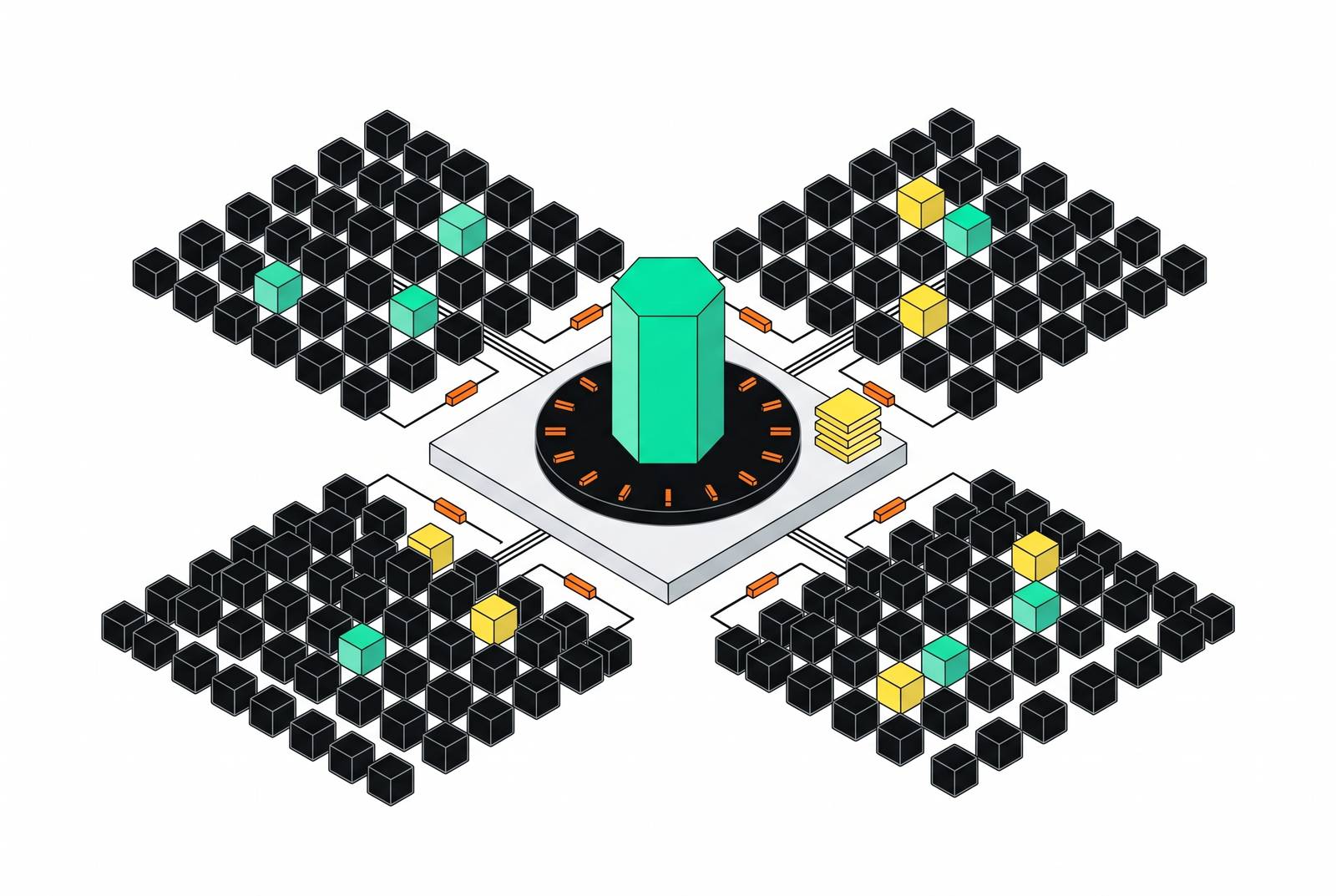
Persistent and scheduled autonomous agents at scale need more than additional workers. Reliable fleets separate schedule triggers from execution, preserve memory between runs, enforce per-agent state ownership, and let urgent work displace routine work. Orchestration topology is the deciding layer because it governs how thousands of agents wake together without overwhelming tools, corrupting shared state, or losing their place.
Why schedule-triggered fleets break differently from request-driven multi-agent systems
A single cron job wakes up, does its work, and finishes. Thousands firing together compete for the same queues, state stores, and tool endpoints before any has done useful work. Nothing has malfunctioned. The schedule has worked exactly as intended, but it has compressed demand into an instant. That synchronized pressure is a scheduler stampede.
SAP’s Autonomous Event-Driven Multi-Agent Orchestration for Enterprise AI at Scale identifies the evaluation gap behind this problem. Much multi-agent evaluation assumes discrete request-response workflows rather than continuous business events with competing priorities. Scheduled fleets expose that distinction at every boundary. Coordination, state synchronization, resource allocation, and communication all face peak demand together, while persistent memory must connect each run to what happened before it.
The four failure modes that only appear at scheduled-fleet scale
Scheduler stampede is the first failure mode. A synchronized activation burst overwhelms queues and downstream tool rate limits even though each agent is healthy. State fan-out begins when those agents write intermediate results into shared stores concurrently. A downstream agent can then act on an inconsistent read, spreading the consequence beyond the original writers.
Priority preemption collapse is a different kind of failure. Routine scheduled work takes up execution capacity while an urgent event waits, even though it has a higher-priority label. Context isolation breach occurs when a shared runtime lets one agent read stale or cross-contaminated context from another agent’s prior run. The agents may still produce answers, but those answers no longer rest on clean boundaries.
A stampede increases pressure on shared state, which delays priority handling and worsens context isolation. There is also a distinct risk within an individual long-running agent. “Context rot” describes accumulated context becoming incoherent enough to degrade the agent’s own plan, without another agent’s information crossing into it.
Why naive horizontal scaling makes all four failure modes worse
More compute does not settle who may write shared state. If additional replicas repeat the same schedule, they multiply simultaneous activations and concurrent writers without changing the underlying contention. Equal-access workers also leave urgency competing with volume, while shared execution environments without identity boundaries leave context exposed. Capacity increases, but the governing rules stay unchanged.
This is why scaling a single-agent runner is not equivalent to scaling an agent system. Without persistence, the expanded fleet still cannot reliably continue from its previous runs. Without coordination, more agents create more opportunities to conflict. The alternative starts with how agents are arranged, how state is owned, and how priority moves through the system, in short, topology.
The topology menu: five patterns and their scheduled-concurrency trade-offs
Parallel Fan-Out works well for large amounts of independent work because agents run without waiting at a supervisor serialization point. Its weakness appears when results require consistent merging. Hierarchical Supervisor trades that independence for central delegation and collection, making coordination explicit but placing a bottleneck where the scheduled burst arrives. Microsoft’s Magentic pattern offers a related, dynamically adaptive manager that chooses specialized agents as context and progress change.
DAG / Graph orchestration makes control flow explicit. The SAP study found that the DAG Plan & Execute implementation it tested generally had higher agent-call precision than ReAct at Enterprise scale, while ReAct had better recall and answer completeness in several conditions. Graphs also provide a natural structure for persistent execution state when workflows need interruption and recovery.
ReAct / Sequential Pipeline remains useful where recall and completeness dominate in smaller registries, but a linear path is vulnerable when one failed node collapses the workflow. Swarm offers parallel specialization but remains a research-mode choice for scheduled fleets. A Task Manager belongs in front of execution patterns when events must be prioritized, merged, or preempted.
Scheduler architecture: separating the trigger plane from the execution plane
The queue is the fleet’s shock absorber. A trigger plane emits schedule events into a durable queue instead of directly commanding execution, and workers drain that queue at a controlled rate. This separates the moment work becomes due from the moment resources become available. The schedule can fire without requiring the whole fleet to execute immediately.
Jitter spreads wake-up times across a window, reducing the concentrated activation burst without changing aggregate throughput. Consumer-level rate limiting then controls execution without discarding events at the scheduler boundary. Priority lanes give urgent work its own path through the backlog. Without them, an orchestrator’s priority decision has no corresponding queue mechanism.
Routing deserves equal attention because available agents are not interchangeable. The SAP study found that a larger discovery space can make agent selection more confusable at Enterprise scale. A scheduler must route events to the right specialists even when other agents have idle capacity. Load leveling solves arrival pressure, but it does not solve agent discovery.
State ownership: deciding what agents share, what they own, and what they never touch
State fan-out is first an ownership problem. Shared coordination state, including assignments, completion signals, and priority flags, belongs to the orchestrator and requires strong consistency, with one writer at a time and many readers. Per-agent working state belongs only to the instance that is running. Completed results, audit logs, and episodic memory become durable output that is append-only after a run closes.
These categories define what an agent must never mutate. Concurrent agents should not rewrite another agent’s working context or alter closed outputs as though they were shared scratch space. Faster locks do not replace that boundary. Nor can retries alone resolve conflicting ownership.
The context window is RAM. It should hold what the current turn requires, while structured retrieval brings other information from the appropriate state tier. That keeps accumulated history from becoming the agent’s entire working context. Authenticated access to each agent’s memory endpoints then enforces ownership.
Memory architecture for persistent agents that remember between scheduled runs
Four memory tiers serve different jobs across scheduled runs. In-context memory holds the current turn, while an external key-value tier retrieves structured facts, configuration, and agent-specific state between turns. Episodic logs keep a record of earlier runs, tool calls, and their outcomes. Semantic vector memory retrieves relevant unstructured knowledge by similarity without replaying the full history.
Episodic records provide experience to draw from, while semantic retrieval helps surface relevant past context. Stable instruction files such as CLAUDE.md, and agent-written indexes such as MEMORY.md, offer a lower-infrastructure way to retain goals and constraints across sessions. They do not by themselves supply the whole memory architecture.
Databricks’ MemCurrent powers Agent Bricks Memory and Genie with live memory reads and writes plus offline consolidation. That separation connects directly to state fan-out. Consolidation keeps memory consistent and fresh without making live runs wait for that work. It is a useful production pattern for keeping memory maintenance from becoming another synchronous coordination burden.
AWS Bedrock AgentCore Memory and Google Vertex AI Memory Bank are managed memory options described as generally available or in preview, while Cloudflare Agent Memory is in private beta. Their relevant category is persistence infrastructure. A fleet still needs the four tiers connected to scheduling, ownership, and lifecycle management.
Protocol choices at the agent-to-tool and agent-to-agent layers
MCP handles agent-to-tool connections, while A2A provides a task-based state machine with streaming and push notifications for agent-to-agent coordination. The distinction follows the work being coordinated. A bounded tool call and a task that remains active across handoffs do not have the same communication needs.
MCP’s 2026-07-28 specification describes a stateless core in which any server instance can answer a request. That supports distributing tool traffic rather than serializing it through a stateful instance. A2A’s task model lets task state be kept and completion notifications be sent without polling. Neither protocol alone contains every tool failure, but its interaction model shapes where shared dependencies can become fleet-wide bottlenecks.
Slack made its MCP server generally available on February 17, 2026, illustrating tool access within an existing workplace environment. Across both communication layers, OpenTelemetry GenAI traces are becoming a way to link observations. Without a link between tool calls and agent handoffs, someone has to piece together what went wrong by hand.
Context isolation and identity: keeping thousands of concurrent agents from contaminating each other
Ownership rules need enforcement at the runtime boundary. Per-agent cryptographic identity limits which memory endpoints, tool connections, and coordination channels an agent may access. Microsoft’s AgentMesh zero-trust approach uses SPIFFE/SVID-based identity for this purpose. Authenticated MCP memory endpoints apply the same boundary to retrieval, so knowing where memory lives does not imply permission to read it.
AgenticOS proposes structured intent declarations. Its architecture synthesizes constrained execution environments with mandatory mediation, auditing, and information-flow rules. This places isolation below application logic. Execution rings and intent mediation add latency, so their cost must be weighed against the risk of cross-agent context breaches.
The connection to state ownership is direct. Per-agent working state remains private only when the runtime can distinguish agents and restrict their access. Identity, isolation, and least privilege therefore belong among runtime primitives. They are not substitutes for careful context management, which must still prevent an agent’s own accumulated history from degrading its plan.
Priority preemption: giving urgent events the ability to displace scheduled work
A priority flag is only a signal. Effective preemption also needs a mechanism to pause, checkpoint, or displace current work so an urgent event can execute. Queue priority lanes provide the upstream path, while the Task Manager makes orchestration decisions about urgency and related events. Neither layer can finish the job alone.
The SAP study tested a Task Manager with priority inference, related-event merging, and preemption in a controlled simulation. It improved related-event answer completeness by more than twenty percentage points at Enterprise scale. Merging reduces redundant invocations when several events concern the same underlying condition. These findings support the architecture, but the study explicitly does not establish production readiness.
Pausing work creates a persistence requirement. An agent cannot safely pick up its work if its intermediate state was lost when execution stopped. Graph frameworks that persist state at each node make checkpointing part of the execution model. The same study also found weaker results in Enterprise registries than smaller ones, showing why priority handling must account for agent-discovery complexity as well as event volume.
Governance and observability across a live scheduled fleet
Fleet observability must connect activations to their consequences. Decision intelligence means tracing an output back to its inputs, model decisions, and tool calls. Correlated traces make those connections visible across tools and agent handoffs. Without them, the fleet can generate work faster than operators can explain it.
The AOS reference architecture separates a Control & Governance Plane from its Runtime & Coordination Plane. Policy, trust, authority, auditability, and human oversight sit beside scheduling and lifecycle management as architectural responsibilities. Human escalation then becomes a workflow operation. The system must pause, keep its state consistent, show a decision, and then pick up where it left off without losing work.
This creates a practical limit on responsible fleet growth. An organization must be able to review, audit, and correct agent behavior at the rate the fleet produces it. Automated policy enforcement must support the fleet as it grows as well as help manage it after launch. Checkpointed workflows make intervention tractable in a way that stateless pipelines cannot.
Matching topology to failure mode: a decision map for fleet architects
Diagnosing the failure comes before selecting the pattern. Stampede-sensitive work calls for trigger/execution separation, jitter, and priority-aware queues, with Parallel Fan-Out suited to independent, precision-insensitive volume. State fan-out calls for explicit ownership and consistent coordination state before storage selection.
Correctness-critical work with interruption requirements points toward DAG orchestration, paired with a Task Manager and durable checkpoints. Hierarchical Supervisor fits where accuracy justifies serialization and the supervisor is not on the schedule’s critical path. Context isolation needs protection at a different layer, with cryptographic identity, mediated access, and execution boundaries that are enforced.
For platform selection, the practical test is whether scheduling, priority queues, persistent memory, execution isolation, and lifecycle management are first-class primitives or separate integrations. Named memory services can reduce persistence work, but that alone does not establish a complete fleet runtime. Reliable scheduled autonomy depends on how those primitives compose under simultaneous load. That is the distinction between hosting more agents and operating a dependable fleet.