Agent Reliability Patterns From Chaos Engineering
Chaos engineering needs rebuilding to catch agent failures that look correct.
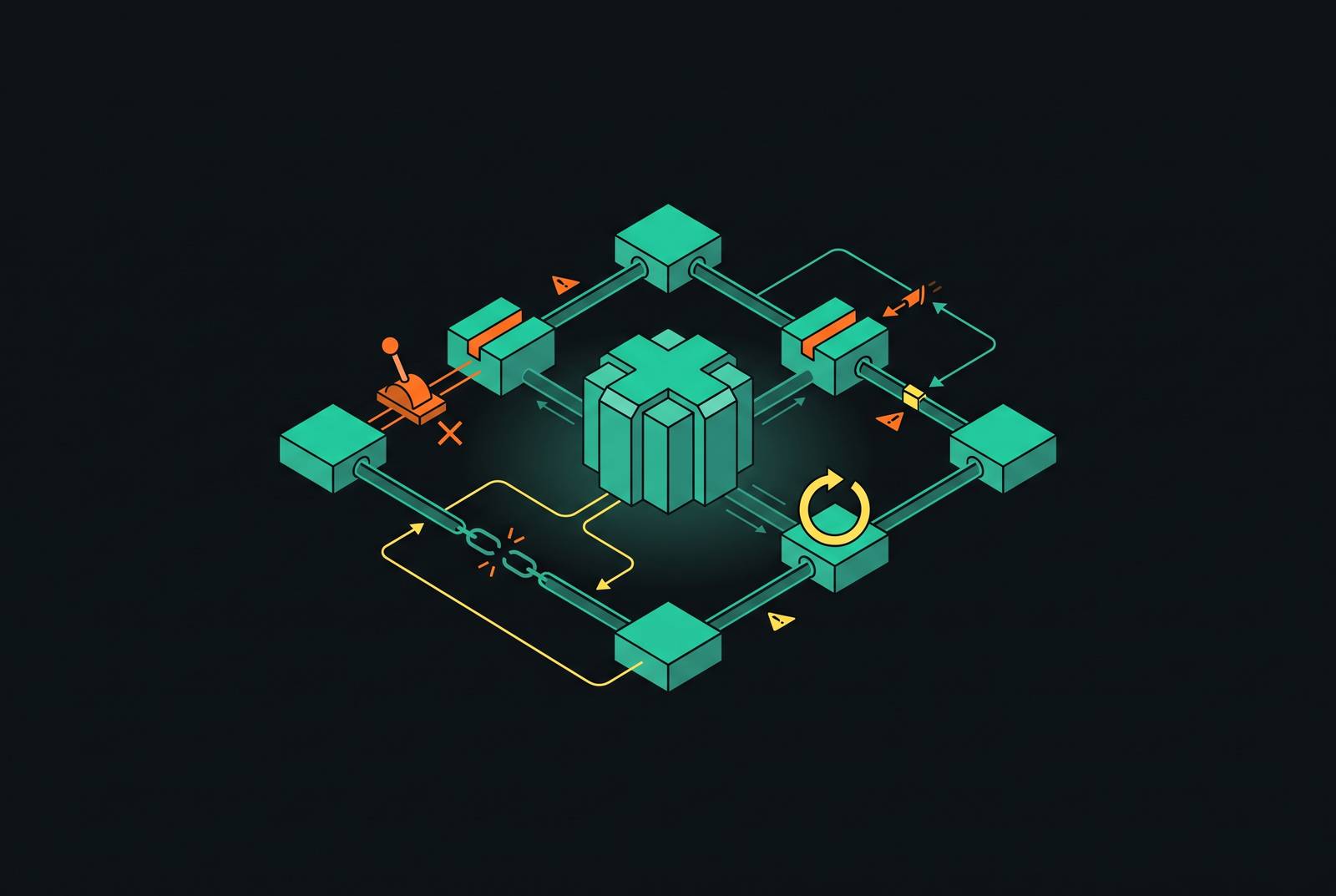
An agent can pass every staging test, handle every scripted scenario, and still look production-ready. Then it ships, meets real traffic, and starts failing in ways nobody scripted for: not crashes, but wrong answers delivered with total confidence. This is the gap this piece is about: classical chaos engineering was never built to catch that kind of failure, and closing the gap means rebuilding the discipline from the ground up.
Why classical chaos engineering breaks for autonomous agents
Classical chaos engineering rests on three assumptions: retries are idempotent, success and failure are binary signals, and rolling back a container image restores the system to health. Those assumptions held for stateless web services for years. They do not hold for autonomous agents, and agents break all three at once.
Retry a failed LLM call and the agent does not simply repeat itself. Failure itself is often semantic rather than operational: a tool returns stale data, a partial LLM response comes out grammatically correct but factually wrong, or the agent finishes its task, raises no error, and hands back output that is simply incorrect.
AgentChaos, presented at ASE '26 (October 12 to 16, 2026, in Munich), lays out the architectural reason this happens. Classical chaos tooling was never built to surface that kind of propagation. Joshua Owotogbe, at Tilburg University, frames the underlying gap precisely: LLM-based multi-agent systems face communication failures, emergent behaviors, and cascading faults that are rarer in standalone LLMs, and traditional testing methods are less effective at catching them.
The conclusion that follows is structural. Fault injection, circuit breaking, rollback, and SLOs all need to be rebuilt from agent-specific first principles before any of them can harden an agent runtime. The rest of this piece works through what that rebuild looks like, pattern by pattern.
The six failure modes that agent chaos testing must target
Agent failures sort into six distinct classes.
LLM-level infrastructure faults, things like rate limits, server errors, timeouts, and stream interruptions, are the most common and the easiest to inject.
Tool call failures appear as API errors, malformed responses, or data mutation. The hard part is that agents often don't validate what a tool hands back; they treat the response as ground truth no matter what it contains. Catching this requires injecting failures directly at the tool layer and checking whether the agent acknowledges the failure or papers over it.
Context degradation erodes coherence over long tasks. Instructions given at the start of a session get overwritten by recent context: an agent told to keep a formal tone starts slipping into casual language by turn 15, or drifts away from strict output constraints as the context window fills up. The erosion is slow, occurs only in long-running tasks, and stays invisible to any monitor watching for availability.
Cascading failures move across agent boundaries. In a multi-agent pipeline, each agent treats the prior agent's output as reliable truth, so a small parsing error in agent A becomes a wrong assumption in agent B, which becomes a confident, fully wrong recommendation by the time agent C delivers it.
Specification drift happens under pressure. Faults make this worse, because improvisation is exactly where specification drift turns dangerous.
Silent failures are the hardest to catch of the six. The agent finishes the task, returns results that look entirely plausible, raises no error, and the results are wrong anyway. Catching this requires chaos testing that includes semantic validation: not just confirming the agent finished, but confirming what it produced is actually correct. That requirement is what the next section builds on.
What quality SLOs must measure instead of availability
A four-nines availability target does not protect against semantic failure, because an agent that returns a wrong answer was still available. A quality SLO has to sit beside the availability SLO, or the error budget ends up measuring the wrong thing.
Closing that gap takes at least three additional signals layered onto the standard four: answer quality, scored by an LLM acting as judge against the production prompt mix; tool-call success rate, tracking tools that return without exhausting retries; and cost per resolved interaction.
The error budget itself needs to count wrong answers, not just failed requests. High-stakes prompt categories, compliance, financial, operational, need their own hallucination-rate threshold, separate from the general quality signal, because the cost of a wrong answer in those categories is not the same as the cost elsewhere.
AgentChaos found that robustness ranking stays consistent across different backbone models. Robustness is a property of how the system is built. That's the operational proof that model-level quality metrics alone aren't enough: the measurement has to live at the system layer, where the actual agent architecture, tool integrations, and recovery logic live.
Persistence and scheduling belong inside the SLO as well. An agent that can't carry state across sessions or act on a schedule can't be held to a quality SLO in any meaningful sense, because it will silently degrade every time its context resets. Without those two, the SLO measures only a fraction of how the agent actually behaves in production.
Building a fault injection framework that works against agent-specific failure modes
Agent chaos testing calls for an architecture classical chaos tooling doesn't have: scenario-based baselines, composable multi-fault injection, and runtime injection at the shared HTTP interface.
Existing fault injection methods don't transfer cleanly. Runtime methods that hijack system prompts or rewrite agent outputs directly require custom re-implementation for every target system, and they can't be applied at all to systems that don't expose the right interfaces.
AgentChaos solves this by injecting at the shared HTTP layer that every agent system already uses to reach its LLM. It also verifies that injected faults actually triggered and filters out untriggered tasks, which avoids underestimating the real impact.
A geocoding API times out while the LLM itself is running slow and the user sends a follow-up message in the middle of it. The agent-chaos-engineering project handles this with composable ChaosPlan objects. The plans themselves are plain JSON, so they can be edited without touching code.
Two fault surfaces here have no real equivalent in classical chaos tooling: chaos.memory() injects stale reads, and chaos.input() injects adversarial noise and spoofing at the sensor or input layer.
A fault that gets injected but gets silently routed around produces a misleadingly healthy result: the fault happened, but it never actually executed where it mattered. That is why AgentChaos verifies whether each injected fault actually triggered and filters out tasks where it didn't, before computing any degradation measurement. Under 65 fault configurations, AgentChaos found every tested system degraded under injection, with pass@1 dropping by as much as 50 percentage points.
The four cognitive-layer recovery patterns
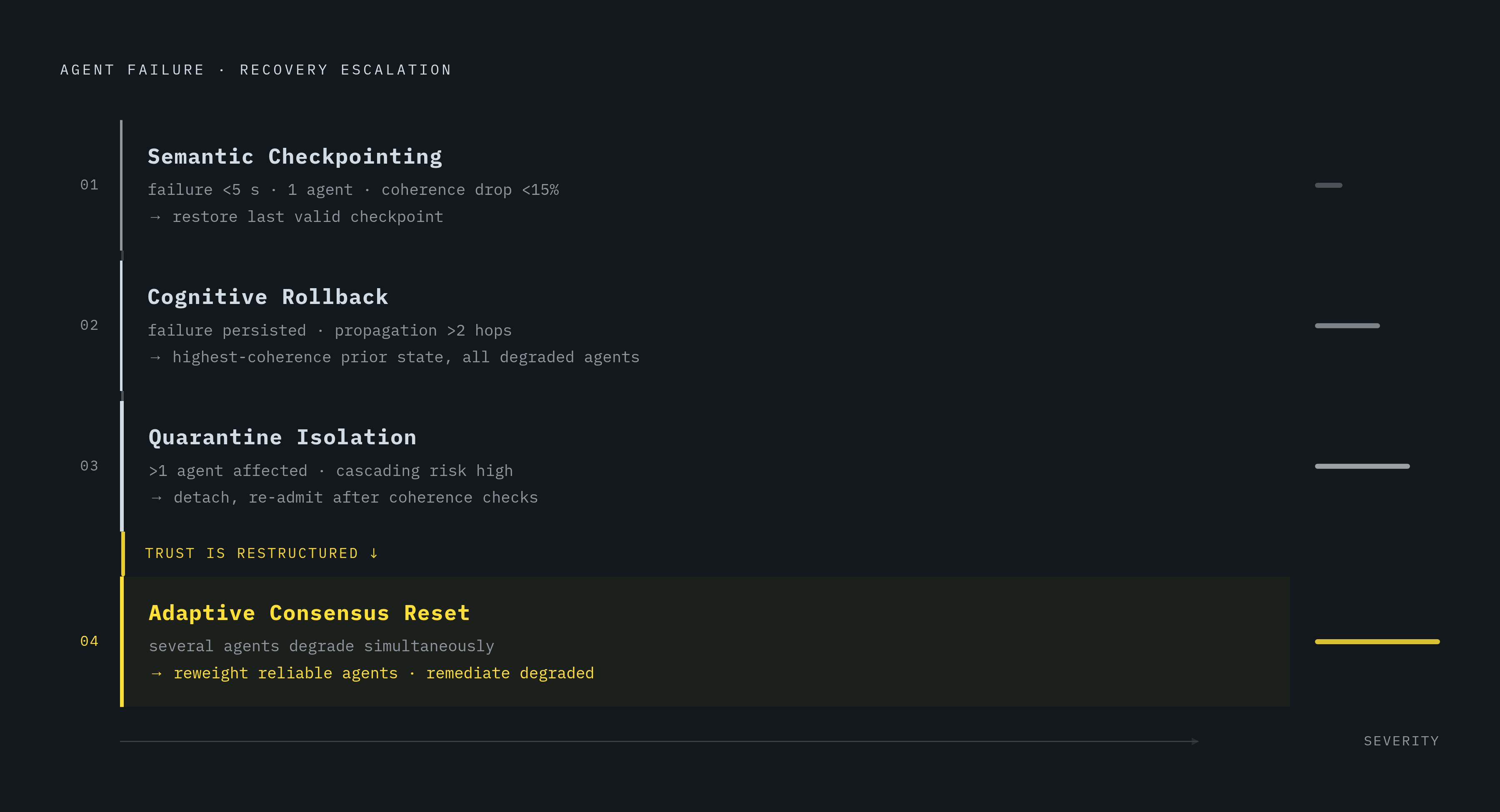
Once a fault is detected, the response still has to match the severity of what happened. Recovery from agent failure needs a hierarchy of four cognitive-layer patterns, ordered by propagation depth and severity. Apply the wrong one, and recovery time gets wasted or corrupted state stays in place longer than it should.
Detection comes first. An anomaly gets flagged when an agent's reasoning variance from its peers exceeds its own historical baseline, or when its semantic coherence (constraints satisfied divided by total constraints) drops below a set threshold. Pattern selection itself works as an optimization that minimizes recovery time plus a weighted sum of affected agents and accuracy retention.
The four patterns, from least to most severe, as defined in the agent-chaos-engineering framework:
| Pattern | Trigger conditions | Action | |---|---|---| | Semantic checkpointing | Failure under 5 seconds old, only one agent affected, coherence drop under 15% | Restore the last checkpoint whose coherence meets threshold | | Cognitive rollback | Failure has persisted longer, propagation depth exceeds two hops, valid prior checkpoint exists | Restore the highest-coherence prior state across every degraded agent, not necessarily the most recent one | | Quarantine isolation | More than one agent affected, cascading risk is high, system can continue in degraded mode | Detach degraded agents, route work around them, re-admit only after a probation period with passing coherence checks | | Adaptive consensus reset | Several agents degrade simultaneously, alternatives exist | Reweight reliable agents upward so their outputs carry more influence while degraded ones get remediated |
Semantic checkpointing has the smallest blast radius and the fastest recovery, reserved for failures caught early and contained to one agent. Cognitive rollback is rollback of reasoning state, not of a container image: it restores the most coherent prior state, which is not always the most recent one. Quarantine isolation buys time by detaching degraded agents from the workflow. Adaptive consensus reset narrows the system's trust toward components that are demonstrably still working, while the degraded ones get fixed in parallel.
Benchmarking against this hierarchy in the agent-chaos-engineering experiments found task success recovering from a degraded baseline to a substantially higher rate once self-healing patterns were applied, with cross-agent failure rate falling significantly. That's evidence the four patterns function as a system, not as a set of isolated mitigations bolted on independently.
Stateful rollback: why agent rollback must be atomic across prompt, tool registry, memory, and vector index
Rolling an agent back to a prior good state is not the same operation as rolling back a deployment. An agent's state is distributed across at least four coupled artifacts, the prompt, the tool registry, memory, and the vector index, and all four need to be restored as a single atomic unit. Restore them out of sync and the rollback leaves the system in a worse inconsistency than the fault it was meant to fix.
A partial rollback, prompt reverted but tool registry still pointing at the old configuration, puts the agent into a state that never existed during normal operation. An on-call engineer responding at 3 a.m. needs a runbook that specifies what to do with an in-flight tool call, beyond instructions for swapping out a container image.
Making this kind of rollback possible at all depends on a tiered memory architecture: in-context working memory, an external key-value store, episodic logs, and a semantic vector store. Each tier carries its own rollback strategy and its own recovery time. A single flat "restore from backup" approach doesn't work for agents the way it does for a database.
Business-critical state, refund status, pending approvals, retry state, final tool results, belongs in durable external stores: a SQL database, an event queue, a workflow orchestrator. Those external stores come with their own rollback and replay primitives built in, and leaning on them is what makes atomic rollback achievable.
New chaos surfaces at the MCP and A2A protocol boundaries
Production agent systems increasingly run on a two-layer protocol stack: MCP for vertical tool integration, and A2A for horizontal coordination between agents. That stack introduces failure surfaces between agents that simply don't exist in single-agent systems, so you need chaos testing at the protocol boundary itself, not just inside each individual agent.
The stack reached a maturity milestone in April 2026, when A2A hit version 1.0 as a stable production standard and shipped alongside signed Agent Cards for verifiable identity. A typical production agent system in 2026 composes the model vendor's SDK for inference, MCP for attaching tools, A2A for exposing the agent to its peers, OAuth for authentication, and OpenTelemetry for tracing execution. Every one of those interface boundaries is a place a fault can be injected.
Three scenarios at this layer have no equivalent in classical distributed-systems testing. Agent Card spoofing, or identity drift, happens when an agent presents a signed Agent Card claiming capabilities it no longer actually has, often after a model change or a tool removal, and downstream agents that act on the card's declared capabilities fail silently as a result. Quarantine isolation at this layer means poisoning the degraded agent's capability advertisement across the mesh, not just routing around it from the inside.
Owotogbe's framework names communication failures in LLM-based multi-agent systems directly as a chaos engineering target, and the difficulty compounds at scale: cascading faults across protocol boundaries are the hardest kind to trace, because each hop transforms the failure signal before it reaches the next agent.
Running a reliability sprint: from chaos baseline to production-ready agent runtime
Agent reliability engineering works best as a named operational function with its own sprint cadence, not a test that runs once before launch and gets forgotten. The discipline needs a baseline measurement, a fault injection campaign, a recovery pattern deployment, and a continuous regression loop that runs on prompts.
A pre-launch reliability sprint starts with baselines: run the full task suite with no fault injection and record pass@1, coherence scores, tool-call success rates, and cost per outcome. From there, the recovery pattern hierarchy gets deployed: the coherence detector instrumented, checkpoint intervals configured, an atomic rollback runbook written, with every artifact, prompt template, tool registry, vector index, memory store, explicitly covered.
And you have to run regression testing on every subsequent model or retrieval change: behavioral tests against the production prompt distribution, not function tests against a synthetic contract.
None of this works without a runtime built to support it. The runtime underneath needs persistent state management across sessions, scheduled execution, semantic checkpointing as a first-class primitive, and audit logging thorough enough to reconstruct state at any prior checkpoint. Agents that can't persist context or act on a schedule collapse the whole reliability model: every session starts cold, cognitive rollback becomes impossible, and quality SLOs can't be measured across tasks.
A purpose-built agent operating system provides these primitives natively. Bolting them onto general-purpose cloud tooling instead means rebuilding memory, scheduling, and audit infrastructure separately, and each piece rebuilt that way becomes its own reliability surface to maintain. The chaos patterns in this piece hold up in production only when the runtime underneath them is built to carry them.