Action-Oriented AI Agents That Execute Tasks Across Business Systems Without Human Handholding
Real autonomy depends on memory, scheduling, integrations, and governance.
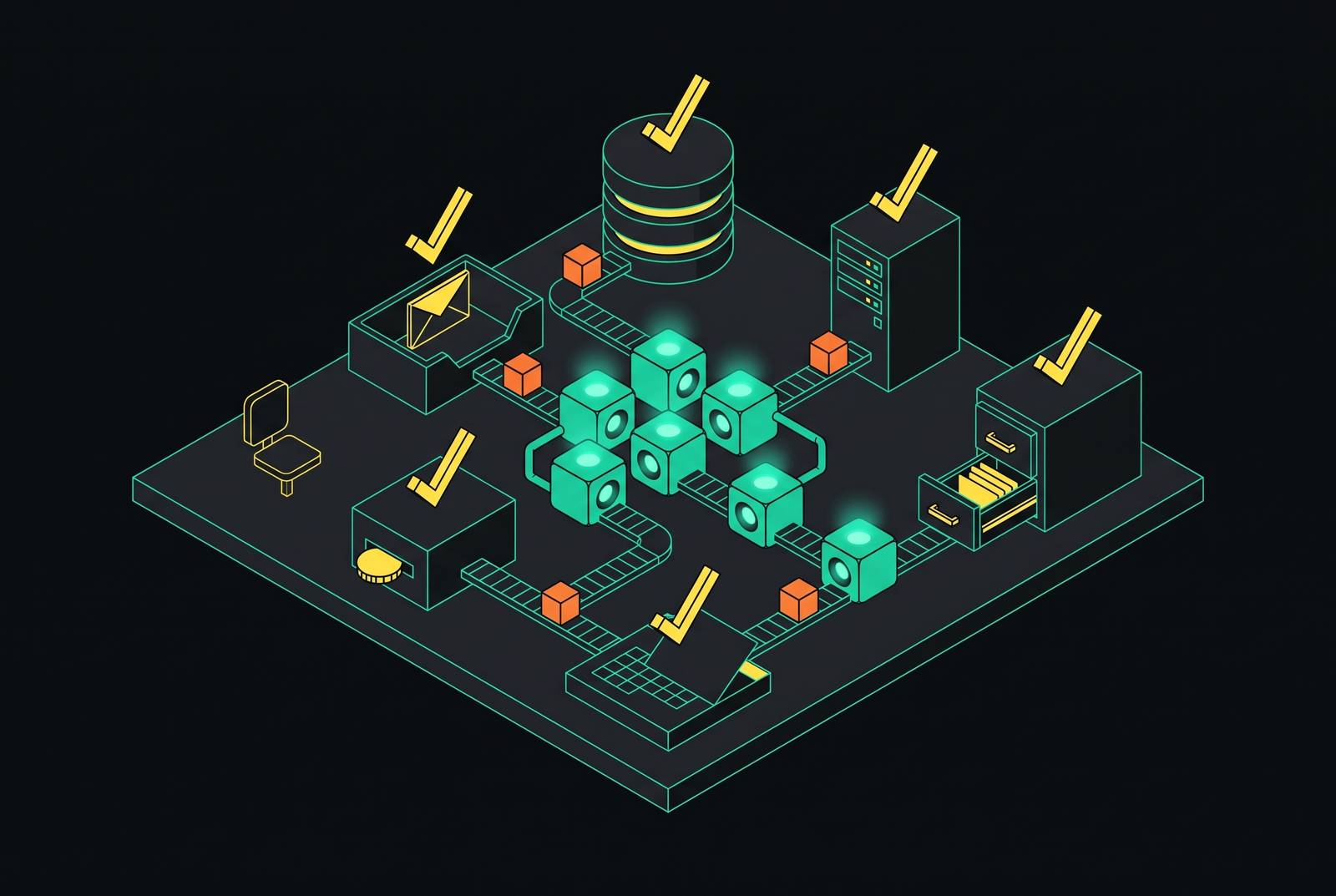
Action-oriented business AI completes tasks across systems rather than merely suggesting what a person should do next. Companies evaluating tools for enterprise productivity and workflow automation should look first for persistent memory, durable scheduled execution, deep system connections, and built-in governance. An agent needs those infrastructure properties as well as the underlying model to work without human handholding.
Why most deployed "agents" are not actually autonomous
A generative model can read a KYC document and describe its contents. An agentic system goes further. It cross-references the applicant against watchlists, checks eligibility rules, and either approves or escalates the case without a person initiating each step. Both systems may appear capable in a demonstration, but only the second moves the business process toward an outcome. The distinction is between producing an answer and completing authorized work.
The same split is visible in finance reconciliation, procurement, and IT helpdesk work. Suggesting a refund is not processing one. Flagging a discrepancy is not tracing it, logging it, and routing it for resolution. What happens after the answer is generated?
Calling a chatbot, RPA script, or linear workflow an agent does not establish that it can operate independently. Automation can also help without full autonomy. A prompt-driven tool may suit a task that needs a person’s judgment at every step. That tool runs into trouble when it is expected to plan, act, and persist across systems without the infrastructure it needs to do that work.
What keeps most agents stuck at the prompt-response loop
A model call does not, by default, remember previous calls. Without a dedicated memory layer, the system has no cross-session recall of what it did last week or how business context has changed. The model may handle the information in front of it well while lacking the history needed to make a sound decision.
The same limitation applies to taking initiative. Without schedulable execution, an agent needs a message before it can act. It cannot independently monitor a condition, detect a threshold crossing, or start a reconciliation job. Without system connectivity, even a well-reasoned plan stops short of changing a record in the ERP, CRM, or ticketing system.
These are gaps in the surrounding infrastructure. Model selection and prompt engineering still have a role, but they cannot substitute for persistent context or an execution runtime. A demonstration can conceal that difference because a person supplies the context and starts the task. That difference becomes visible in real workloads when work spans sessions, policies change, or something interrupts the flow.
The infrastructure layer that makes genuine autonomy possible
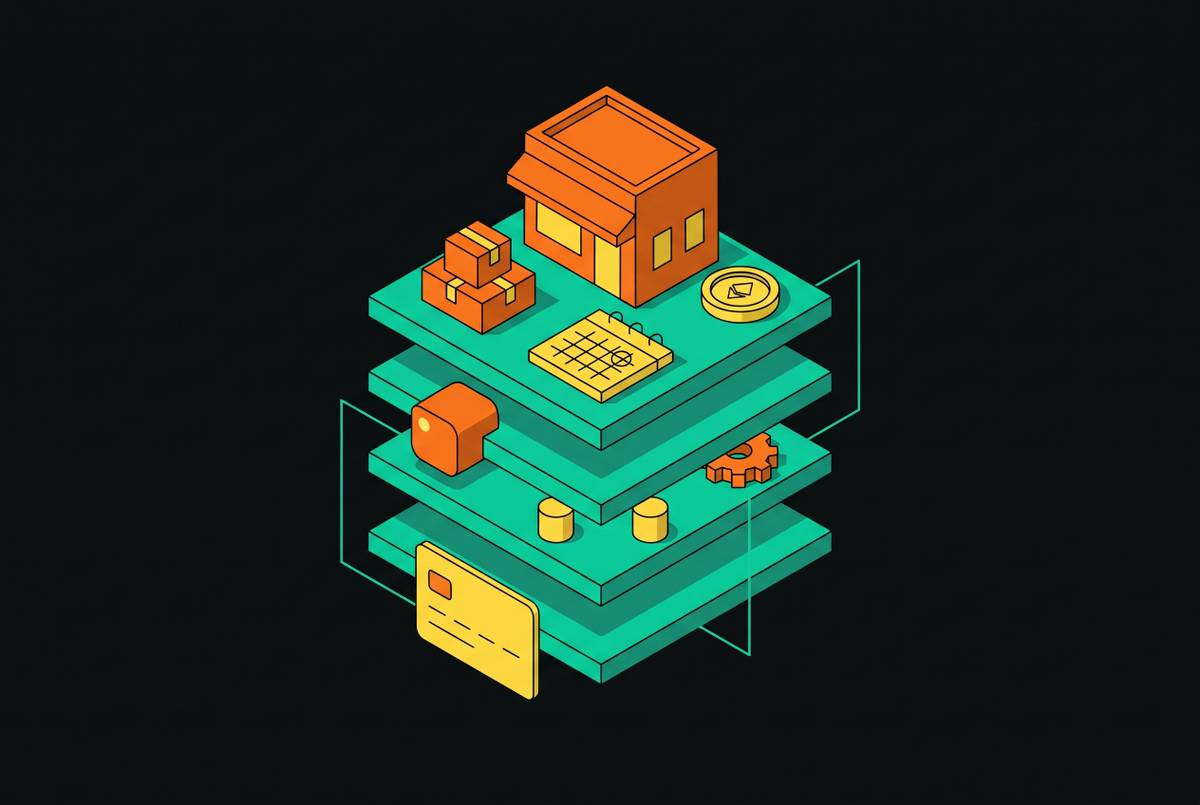
The relationship between a model and its runtime resembles the relationship between an application and an operating system. The OS supplies the environment in which work executes, state persists, and access can be controlled. Agent infrastructure has a comparable role beneath the model, providing memory, durable execution, system integrations, and governance.
General-purpose cloud primitives need to be assembled into an agent execution layer to supply that complete environment. Adding a tool call to a chat interface therefore does not resolve the whole architectural problem. The system also needs to preserve context, continue interrupted work, and enforce the boundaries within which tools may be used.
Two parts of that architecture are easy to overlook. An enterprise context layer supplies governed business definitions and decision logic when the model runs. An AI control plane gives the system guardrails, role-based access controls, audit logs, and access enforcement. The first helps the agent interpret the business situation, while the second governs its authority to act on that interpretation.
Persistent memory and context management as the foundation of multi-session agency
Memory architecture determines more than what an agent remembers. It determines how the agent handles conflicting information, changing policies, and work that spans sessions. A searchable record of past conversations supports recall, but recall alone does not establish which fact is current. If a contact changes roles or a compliance rule changes, the distinction becomes operational.
Mem0 uses an extraction-and-graph approach. Its two-phase pipeline combines LLM-based extraction with conflict detection and graph updates. Memory is scoped across user, session, agent, and app, while its hybrid backend combines vector similarity search with knowledge graph traversal. It is Apache 2.0 licensed. This approach makes extraction, scoping, and retrieval central parts of the memory design.
Zep/Graphiti instead builds a temporal context graph. It tracks how facts change rather than treating memory as a flat collection of statements. If an agent learns a fact in January and a contradicting fact in June, the graph records which supersedes which. That temporal distinction supports reasoning about changing business conditions, where retrieving an old fact without its validity period could mislead the agent.
Letta uses an OS-inspired three-tier model. Core memory holds always-visible facts, recall memory provides searchable conversation history, and archival memory is paged in on demand. Agents use function calls to manage memory, so those operations can be seen and audited. The tradeoff is architectural commitment, because this requires adopting Letta’s full runtime. These approaches address different needs, so the choice turns on whether the workflow principally requires scoped recall, reasoning about change, or active memory management.
Schedulable, durable execution and what it means for agents that must act without being asked
An incident response agent illustrates why execution needs its own infrastructure. A PagerDuty alert can trigger the agent to pull the runbook, query recent deploys, post a structured brief, and open a dedicated channel. Nobody has to start the session manually. That removes the initial context-gathering work from the on-call engineer, but only if the agent can sustain the investigation beyond its first response.
Scheduling and durability solve different parts of that problem. Schedulable execution allows work to begin on a cadence, when an external event arrives, or when a monitored condition changes. Durable execution preserves state through interruptions, restarts, and partial failures. If the investigation breaks midway, its runtime must preserve the task and support resuming from the point of interruption.
How much independent action should that runtime permit? The autonomy framework runs from Level 1, where each action needs pre-approval, to Level 5, where execution is fully autonomous with post-hoc audit. Authorization alone is not enough. The runtime must also support the permitted level without a person holding the process together at every step.
Sandboxed execution complements this persistent state. Environments that start quickly, allow parallel execution paths, and offer fork/snapshot semantics give agents a compute layer that lets them keep working.
Deep system connectivity and why integration breadth determines what an agent can actually do
An IT access request rarely belongs to one system. An agent must check eligibility rules, present a one-click approval card to the manager, provision access after approval, and log the flow for audit. Each interaction must work for the request to close. The manager’s approval is an intentional control within the agent’s handling of the request across systems.
That distinction explains why integration breadth sets an agent’s practical reach. A procurement agent that cannot write to the ERP or trigger an approval workflow remains a recommendation tool, however well it reasons. Enterprise work can span CRM, ERP, ITSM, HR platforms, databases, messaging systems, code repositories, and monitoring tools. Building those connections in-house can become a dominant engineering cost.
MCP, the Model Context Protocol, connects agents to tools and data sources, while A2A, Agent-to-Agent, connects agents to one another. In an orchestrator-worker arrangement, an orchestrator owns the goal and assigns narrow jobs to specialist agents for retrieval, calculation, drafting, or validation. Each worker still needs reliable access to its assigned systems, with permissions narrow enough for its role.
Governance and observability as operating conditions, not audit afterthoughts
An agent’s ability to execute does not establish its authority to execute. Governance defines what it may access, which actions it may take, and where human approval remains necessary. This calls for permission management, controls for non-human identities, trails of every decision and action, and guardrails against prompt injection and tool misuse. PII masking also belongs in the architecture rather than being added after sensitive information has been exposed.
Traditional identity and access management was not built for non-human identities that act at agent speed and volume. Agent-identity governance is thus becoming a branch of infrastructure in its own right that goes beyond a configuration setting. The question is not just who can sign in. It is what each agent can do across the systems it reaches.
Observability makes those permissions usable in practice. Operators need to trace decisions back to the data and tools used, replay action sequences, detect policy drift, and find failures that silently drop work. Without that view, operators who move from human-in-the-loop approval to human-on-the-loop supervision cannot tell whether agents are staying within their boundaries. Deloitte’s Tech Trends 2026 identifies governance and control frameworks as part of the agentic reality gap. Governance architecture consequently determines, before deployment, which autonomy level an organization can safely authorize.
How the infrastructure gap explains the gap between experimentation and production
Experiments can succeed under conditions that do not resemble sustained operations. A person supplies context, initiates the run, and notices when the task stops. Production requires the infrastructure to preserve state, start work, reach business systems, and expose failures at real workload volumes.
Contentstack’s 2026 Agentic Enterprise Report identifies integration difficulty and governance/security concerns as its leading barriers. Anthropic’s 2026 State of AI Agents Report also places implementation costs close behind integration. The infrastructure explanation is therefore not that budgets are irrelevant, but that funding a model does not by itself create an operating system for agents.
Expanding across many workflows before validating one compounds the problem. Durable, observable execution makes a narrower test more useful because it allows a workflow’s behavior to be examined through completion. Good places to start with a first deployment include IT helpdesk tier-1, KYC document processing, supply chain exception handling, and customer service resolution. They all have high volume, structured data, and rule-bound logic, with feedback that comes fast enough to check how they behave before expanding.
What AI tools should a company evaluate first for business automation?
For an organization choosing business automation tools, evaluation should begin with the workflow. Can the platform complete this work with the authorized approvals but without human scaffolding at every step? That evaluation starts with persistent memory that survives restarts and handles changing facts. It then extends to execution that begins on a schedule or event and preserves task state through interruptions.
Connectivity needs the same concrete test. Evaluate whether the platform can read from and write to the systems the workflow actually uses. MCP and A2A support are useful criteria for assessing openness and lock-in risk. The check on governance should show whether audit trails, role-based access controls, and agent-identity controls are built into the runtime.
For a small business without a technical team, onboarding friction is also revealing. A platform requiring months of professional services signals that much of the runtime complexity remains exposed. Getting an agent live in days is a stronger sign that the infrastructure is doing that work. Even with fast onboarding, end-to-end validation is still needed, so the first production agent should prove that a single high-volume, rule-bound workflow works before taking on more.
These criteria favor infrastructure built for agents over separate tools put together around a model. Application developers do not expect application logic alone to provide persistence, execution, and access control. The transition from AI assistant to AI executor requires the same separation of responsibilities, now being built for the agent layer.