Agentic Compounding How AI Systems Build on Their Own Outputs to Accelerate Business Growth
AI systems gain compounding returns by retaining and reusing their work.
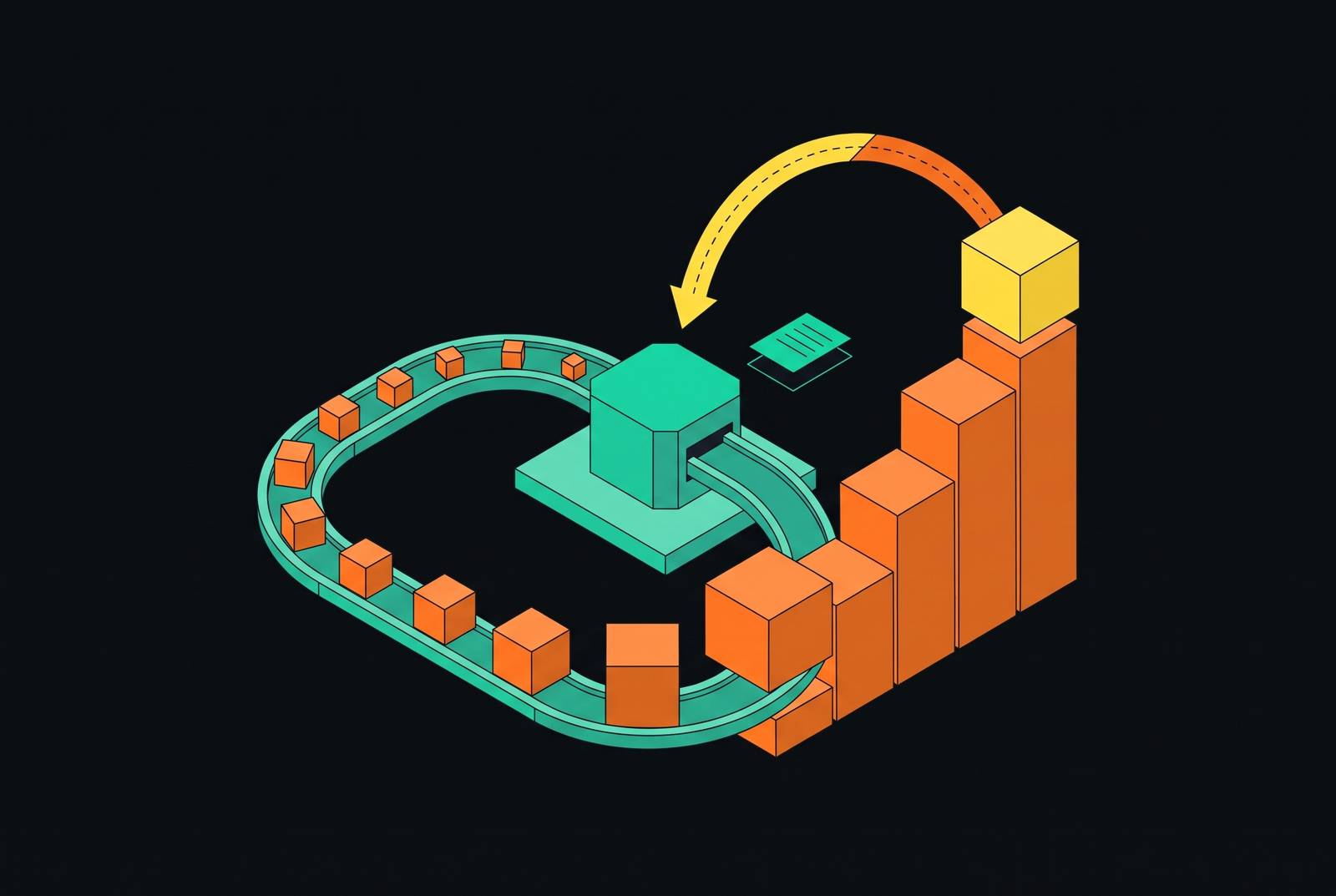
Agentic compounding is the process by which AI systems turn completed work into data, reusable integrations, learned exceptions, and organizational confidence that improve the next cycle. For business AI, the strongest starting point is a narrow, high-volume workflow supported by durable memory, tool connections, and human review. The advantage comes not simply from automating more tasks, but from retaining what each task teaches the organization.
Why agentic AI compounds where automation plateaus
An invoice-processing agent can do more than process invoices. It can also build a dataset of the exceptions it encounters, giving better anomaly detection something to learn from. Better detection can then catch more fraud and errors in later invoices. The output becomes an input for future work.
Standard automation works more like a one-way pipe. An input enters, an output leaves, and the underlying process stays the same unless someone changes it. An agentic system instead perceives, plans, acts, observes, and repeats in pursuit of a goal. The observation step lets the system keep results it can use after the task is done.
But does an agent improve merely because it runs again? No, because repetition alone does not preserve learning. What the system observes must become context it can use, a better detection model, or a handled exception that changes how it does later work. Without that connection, even goal-directed AI can deliver efficiencies that remain isolated.
What enables the loop: the three structural shifts that made agentic compounding possible
Standardized tool connectivity, reasoning-capable models, and persistent memory converged in 2025–2026 to make this loop deployable. MCP gave agents a standard way to connect to databases, APIs, and SaaS systems, cutting the custom integration work that made each deployment slow and expensive. Connections became more reusable across successive agent deployments. Roughly 97 million downloads per month as of February 2026 reflect the ecosystem’s convergence on a shared connector layer. That layer gives agents access to business context without requiring each new deployment to build every connection afresh.
Reasoning models changed how much work an agent could complete before needing help. Tasks that previously required multi-step chains with human checkpoints could increasingly be handled by single-call agents. This expands the useful scope of each cycle. It changes where oversight is needed. A system that can work through more of a task before escalating has more opportunity to produce a complete, reusable result.
Persistent memory keeps those results for future work. Memory cannot do that if it disappears when the system restarts or stays buried in records that later agents cannot use. Durable, structured context therefore became an architectural requirement. Connectivity supplies context, reasoning supports execution, and memory preserves useful outputs. A governance layer of confidence thresholds, audit logs, and escalation paths must surround that architecture so that greater capability does not mean unchecked authority.
How outputs accumulate into durable infrastructure across agent cycles
Consider what remains after the invoice agent finishes a run. Beyond the processed invoices, it produces structured records of what it saw, what it decided, and which cases needed help. Those records become a training signal rooted in the organization’s own work. They are not interchangeable with general model knowledge. With each cycle, the data captures more of the business’s own exceptions and decisions, which a competitor cannot simply buy with the same model subscription.
The agent also leaves behind working connections to the systems involved. The first connection to an ERP requires integration work, authentication flows, and tested data schemas. Later agents can inherit that foundation. Reuse lowers the cost of the next deployment. A working connection becomes infrastructure reusable across agents.
Next come the exceptions that once interrupted the workflow. A case requiring human intervention in cycle one can become a handled case by cycle three when the resolution is encoded for future use. The review queue then has less repeat work. As exception rates fall, the organization has a basis for considering wider autonomy without simply accepting more risk.
Finally, verified task completion builds organizational confidence. That confidence has an operational effect because it influences what the next agent is permitted to attempt. WNS’s 2026 analysis argues that redesigning workflows around coordinated human-AI ecosystems enables compounding value, rather than merely adding agents to existing processes. Persistent, structured context, including semantic knowledge graphs, makes the accumulated knowledge addressable by future agents.
Where the flywheel is already turning: the functions compounding fastest in 2026
MarketsandMarkets identifies IT & ITeS as the fastest-growing end-user segment through 2033, driven by agents that investigate incidents, generate and test code, recommend or execute remediation, and coordinate development activities. These workflows produce rich telemetry as work happens. That telemetry supplies context for later cycles, making IT and security operations a clear example of execution generating the material for improvement.
Sales and revenue operations work the same way. Agents that monitor CRM activity, qualify inbound leads, and update pipeline data keep structured records of those interactions, which can improve lead scoring from one cycle to the next. The work of qualifying leads this quarter therefore gives the qualification model better inputs for the next.
Recruiting offers a parallel path through a different workflow. Agents can compress a multi-week cycle into days by screening applications, scheduling interviews, collecting structured feedback, and generating offer letters. Each hiring run also accumulates feedback that can refine the screening model used in the next run.
Why do these functions lend themselves to compounding? They have high transaction volume, rules-driven logic, and digital records that agents can use as structured context. Their records are a byproduct of doing the work. With so many transactions, agents have frequent chances to use those records. The common pattern is more revealing than the differences between the departments.
The gap that opens between organizations that run the loop and those that don't
Once useful outputs accumulate, two organizations using similar models can operate on very different foundations. One may have an exception library, reusable connections, and structured records from many completed cycles. The other may still be assembling its first workflow. The organizations differ in cost per transaction and in the depth of institutional knowledge available to the system when the next task arrives.
Could a late mover simply buy a better model? A better model may let it do more, but access to that model does not give it another organization’s data, tested integrations, or history of resolved exceptions. Nor does it build the confidence needed to let agents take on more work. Those assets come from running the process and checking how well it works.
This is not only a divide between adopters and non-adopters. WNS argues that organizations adding agents to existing workflows gain incremental efficiency, while those redesigning the work around coordinated human-AI execution can realize compounding value. An adopter can still fail to retain useful outputs. The competitive gap grows when one organization repeatedly turns results into infrastructure and another repeatedly starts from a thinner base.
That distinction also limits the early-mover argument. Starting sooner helps only if the loop keeps what it learns and uses it safely. Time spent running disconnected tasks is not equivalent to time spent compounding. The strategic advantage depends on accumulated, usable outputs rather than an early announcement or a large number of agents.
What organizations need in place for the loop to sustain rather than stall
Durable memory is the first requirement for sustained accumulation. Outputs must survive restarts and remain addressable by future agents, which requires more than attaching a vector database as an afterthought. Structured context must grow with the work. Knowledge graphs can help build that context across interactions, while persistence keeps it in place between sessions of a long-lived process.
Auditability lets an organization check what the system has learned. Event-sourced runtimes treat state as an append-only log, supporting exact replay of recorded execution so that prior states and decisions can be reconstructed and compared. That gives exception handling a record to learn from. Without audit records it can use, an organization may know that a task failed but lack the context needed to do better next time.
Governance sets the rules for how evidence changes what an agent is allowed to do. Confidence thresholds trigger human review, and a reliable track record can justify widening the range of work handled autonomously. Human intervention is part of the design. It supplies a controlled checkpoint. This is how organizational confidence becomes an input to execution instead of remaining a vague feeling about the technology.
The runtime must support that arrangement over time. Agentic workloads are long-lived, goal-directed, and probabilistic, unlike the deterministic programs and human-initiated workflows around which classical operating systems were designed. They need governed identity, isolation, audit, and rollback for activity that can span days. A general-purpose cloud foundation alone does not provide the complete loop. Purpose-built agent runtimes add the controls needed to govern an autonomous process as it runs tasks.
Persistence must also be paired with proactivity. An agent that loses context between sessions or needs a human to restart it for scheduled work can only run tasks that do not build on one another. A company comparing business AI platforms needs to check for these features when choosing one. WNS identifies operating-model redesign as the defining factor in scaling impact. The runtime supports that redesign, but cannot substitute for it.
Starting the loop: the sequencing that determines whether compounding begins or stalls on the first cycle
Begin with one well-defined, high-volume process that already causes pain. Its data exhaust deserves as much attention as its workload. A process that naturally generates structured, reusable records gives the next cycle something to build on. Starting with a complex cross-functional workflow adds scope before the organization has proved that it can preserve and reuse the results.
Conservative autonomy thresholds give the first workflow room to establish a track record. Measurement must begin with the first cycle. Confidence scores, exception rates, and task completion records show how well the agent works and whether it is ready to take on more. Without them, trust has little to rest on. Scope should grow after the agent has earned it in the initial workflow.
The business case needs the same discipline. A narrow use case makes it possible to test whether the result justifies its cost and whether the risk controls work before scaling. Adoption figures are not production figures. Likewise, finishing a task successfully does not by itself prove that the returns will last. Proving business value and the cost case comes before extending the system into more work.
For an engineering team, the minimum viable loop is concrete. It consists of a curl-installable agent runtime, a single tool integration via MCP, a defined goal with a measurable completion condition, and a logging layer that captures every exception. That is a starting point for a full enterprise rollout. Its purpose is to prove that completed work leaves behind something the next cycle can use.
The organizations that will be difficult to compete with in two years are not necessarily those with the largest AI budgets today. They are those that started a useful loop early and kept it running under controls that let learning accumulate. Their advantage will reflect time spent building reusable knowledge.