Choosing AI Tools for Business Operations by Agent Architecture
Architecture determines whether an AI tool can finish the job, not a feature checklist.
Choosing AI tools for business operations starts with agent architecture. The right tool must match the work through its memory, tool access, orchestration, permissions, and execution environment. For business AI procurement, that means choosing the workflow pattern first, then shortlisting platforms that can run it safely and retain context when the work outlasts a conversation.
Why feature checklists fail when buying AI tools for business operations
A buyer can compare pages of nearly identical promises and still not know whether a tool can finish a job. “Agent” may describe a chatbot, an assistant, or a system that acts across business applications. The label does not settle the question. Gartner calls the rebranding of existing products without substantial agentic capabilities “agent washing.”
A useful working definition has three parts. An agent perceives state from the systems it operates on, decides what to do next within defined guardrails, and acts on real systems. A feature checklist rarely establishes all three. Architecture exposes the difference because it shows how the product remembers, chooses tools, coordinates work, and executes actions.
What architecture actually means for an AI agent — the five layers every production system has
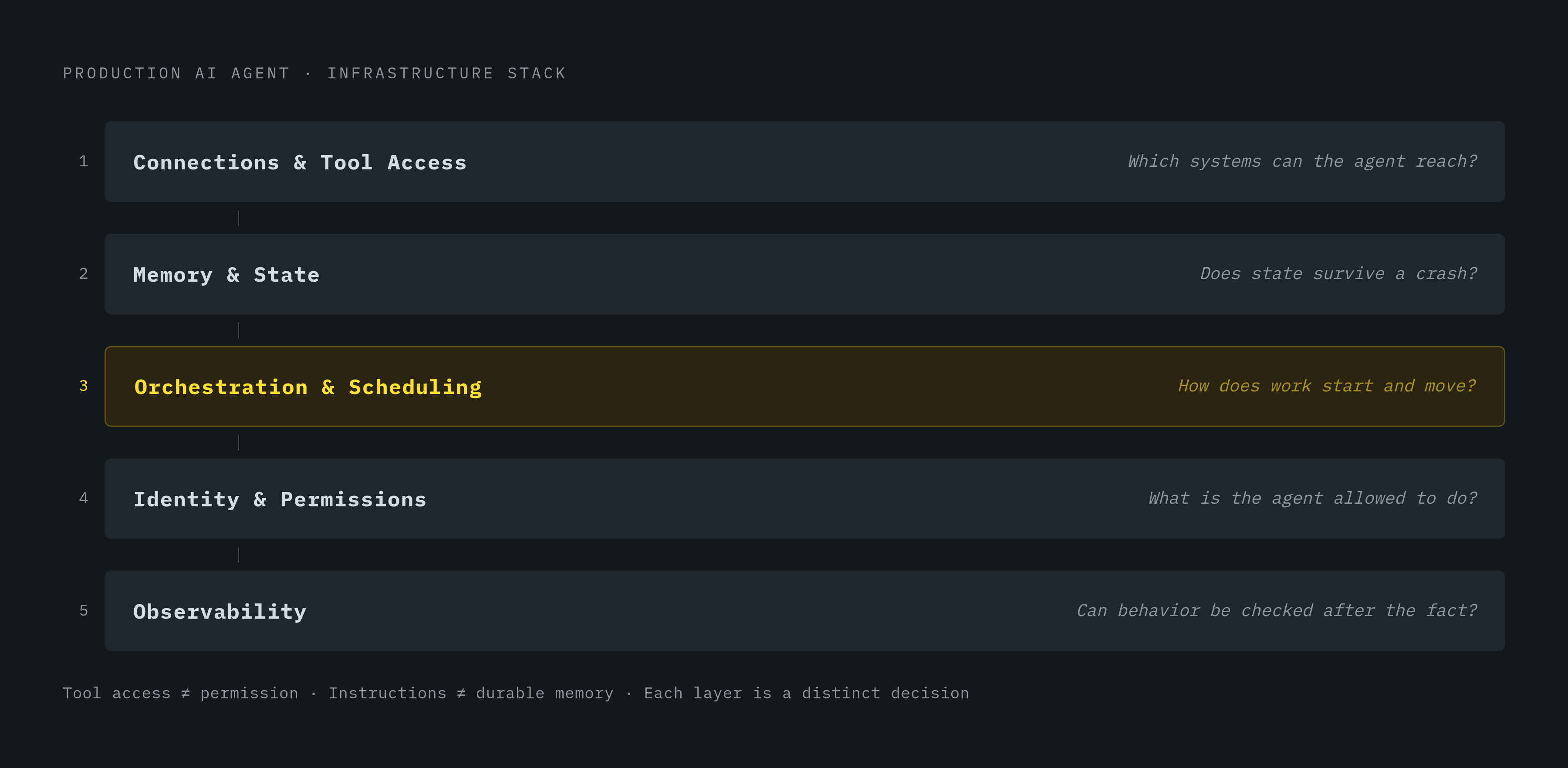
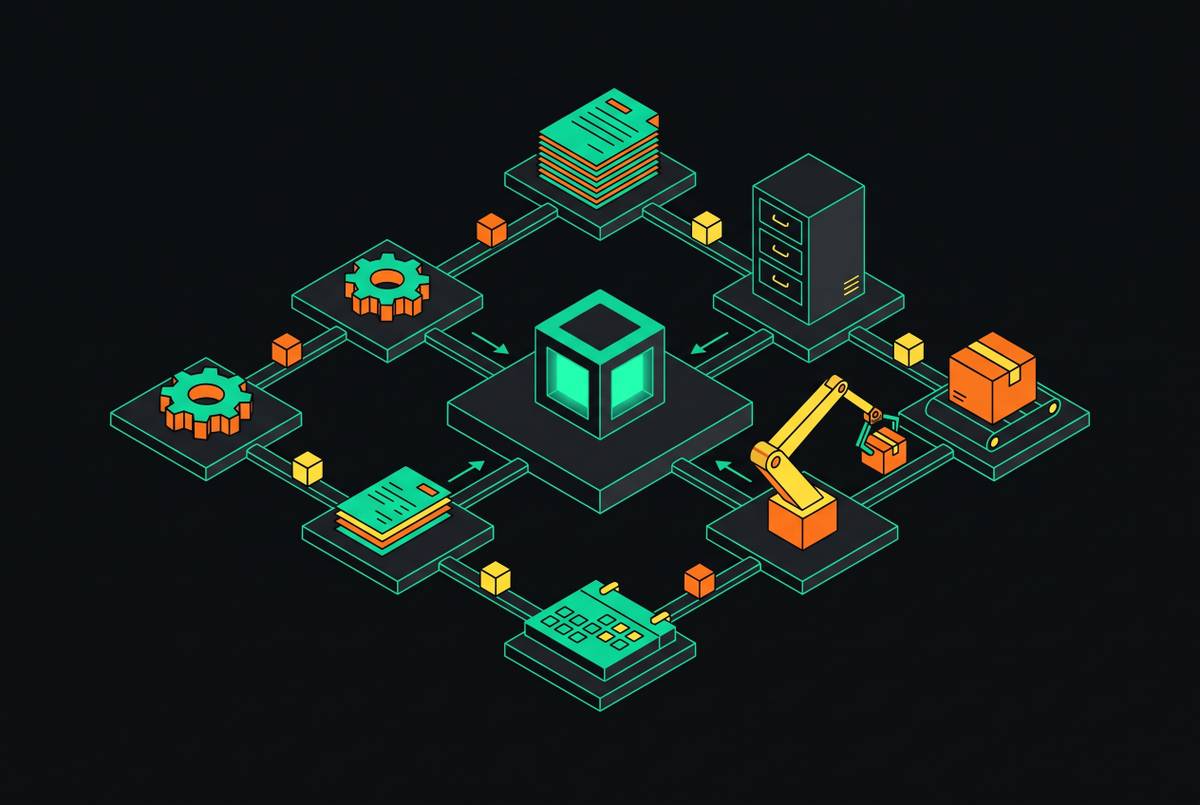
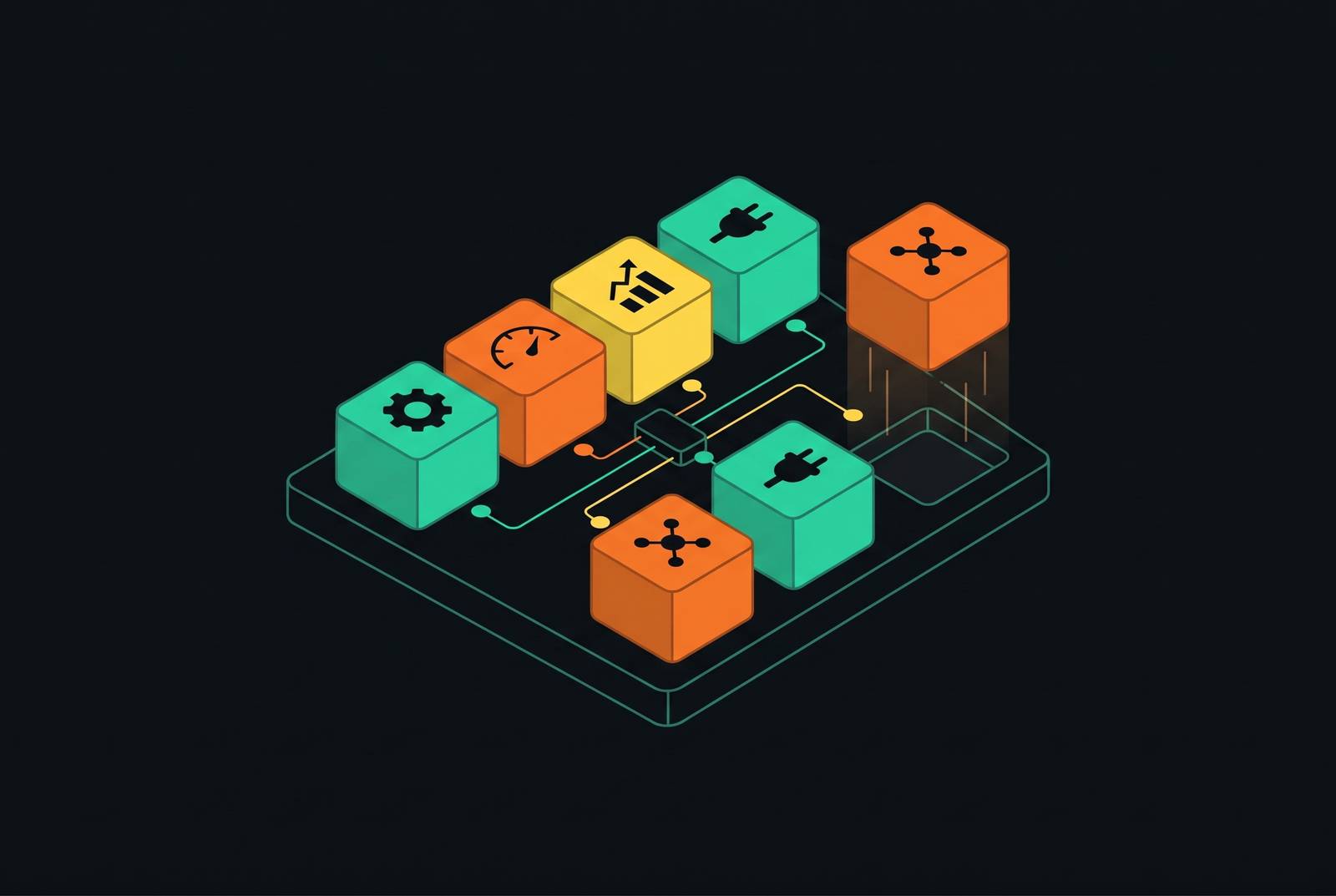
For procurement, the infrastructure can be examined through five practical layers. Connections and tool access determine which systems the agent can reach and what actions it can perform. Memory and state hold what it knows across runs, sessions, and other agents. Orchestration and scheduling determine how work starts, progresses, and moves between agents or people. Identity and permissions set what the agent can access, and observability keeps a record of what it does so its behavior can be checked.
These layers answer different questions about the same task. Tool access is not permission to use every tool, and an instruction is not durable memory. The system prompt supplies instructions on each run, identity establishes the agent’s persistent role and permissions, and its assigned role defines the work it owns. An append-only message log records state. Persisting that log supports crash recovery, session resumption, and debugging.
Scheduling sets apart help that waits for a prompt from work that starts through polling, webhooks, or a schedule. Resource management, scheduling, memory, input and output, and permissions all need a home, with an immutable audit trail making their effects inspectable.
The eight architectural patterns that production agents actually use
The patterns in this framework describe how those layers work together. ReAct uses a Thought → Action → Observation loop, while another pattern separates planning from execution and a third adds self-critique. Prompt chaining follows known steps, routing directs work to the right path, and parallelization investigates several signals at once. Delegation hierarchies share out work among agents and sub-agents. The eighth pattern, tiered constraints, arranges instructions in explicit priority layers.
ReAct suits work where the next tool depends on what the last action revealed. Its interpretable reasoning chain helps with compliance-sensitive investigation because reviewers need to see how it reached a conclusion. The loop adapts as evidence arrives. That makes it a different choice from a fixed sequence whose next step is known in advance.
Plan-and-Execute fits structured, high-volume workflows because a frontier model can make the plan and smaller models or tools can carry it out. That division can lower cost and latency. Reflection serves a different need by adding a check of the agent’s own output before action. These patterns are not interchangeable quality levels, and a platform supporting only one may be a poor fit for a varied enterprise workload.
Tiered constraints also need a careful distinction. A system prompt can function as a constitutional document, setting priorities. But instructions are not deterministic policy enforcement. For procurement, the test is whether infrastructure enforces permissions and governance, including within delegation hierarchies.
How memory architecture separates agents that hold context from agents that forget everything
Memory can fail without any sign until a workflow breaks halfway through. LLMs have no built-in memory between calls, so they must be designed to keep context. A successful demonstration does not establish that design. Production readiness depends on whether the agent can recover the relevant state after its immediate context disappears.
Four memory functions help diagnose the answer. In-context working memory holds recent turns, the current scratchpad, and a small set of retrieved memories. External key-value memory gives fast access to structured state, and episodic logs let the agent search the history of a conversation. Semantic vector memory retrieves unstructured knowledge by similarity. Each has its own use and costs.
These functions fit in a two-tier storage architecture. The context window acts as RAM, holding the material needed now, while a persistent SQL store, vector index, or dedicated framework holds the rest and supplies it on demand. Persistence alone is not the whole test. Where does state live, who can read it, does it survive a crash, and can the session resume?
What AI tools should a company use for different business operations?
For code changes and software delivery, the architectural requirement is autonomous tool loops combined with delegation hierarchies and strong sandbox isolation. Episodic logs keep the history of changes, and separate sub-agent contexts keep them from mixing through cross-contamination. The agent needs a microVM sandbox to run unfamiliar code without putting nearby systems at risk. Long sessions make recovery a basic requirement. Cursor documented agents running for close to a week and writing over a million lines of code across a thousand files, illustrating the scale that durable state must support.
For incident investigation, ReAct provides an interpretable path through evidence, while parallelization correlates signals across deployments, feature flags, and infrastructure changes. Memory needs episodic logs tied to system state at the incident, with an auditable reasoning trace. The runtime must also support a human handoff. Harness introduced the Human-Aware Change Agent on January 20, 2026, to listen to team dialogue, correlate observations with changes, and surface evidence-backed hypotheses. A human approval gate lets engineers approve or reject those hypotheses rather than treating an investigation as permission to act.
For data analysis and reporting, a pattern that separates planning from execution keeps the analytical plan separate from data pulls and transformations performed by smaller models or tools. Semantic vector memory can find past analyses that fit the task, and external key-value memory holds structured query results. Integration is the decisive requirement for the shortlist. MCP-standard access to actual data stores allows those connections to be swapped as infrastructure changes, unlike dependence on hard-coded connectors.
For internal tooling such as IT provisioning, HR, and helpdesk work, known steps belong in a fixed prompt-chaining pipeline, with routing for ambiguous cases and human approvals. Persistent identity and permissions set what a user may ask for before an action happens. The work surface also affects the fit. Enjo operates inside Slack or Teams, applying identity and permissions, retrieving information, and creating Jira or ServiceNow tickets in the same thread. Salesforce Agentforce shows agent actions in Slack, and Make puts agent configuration and execution in one scenario builder canvas, so each cuts context-switching in a different way.
Why the runtime layer is the selection decision most buyers miss
The runtime provisions, isolates, scales, and runs the agent as a process with compute, boundaries, and state. It is distinct from the model and the framework that defines agent logic. That distinction is easy to miss in a demo. In production, a chosen pattern needs the runtime to run safely and durably.
The runtime market presents three broad choices. Managed hyperscaler runtimes include AWS Bedrock AgentCore, Google’s Agent Runtime under Gemini Enterprise Agent Platform, and Foundry Agent Service, with a fit for agents under strict enterprise governance. Framework-native platforms include orchestration and runtime with the framework a team already uses. Sandbox and serverless runtimes address another set of execution needs. For agents that run code, microVM isolation fits the work.
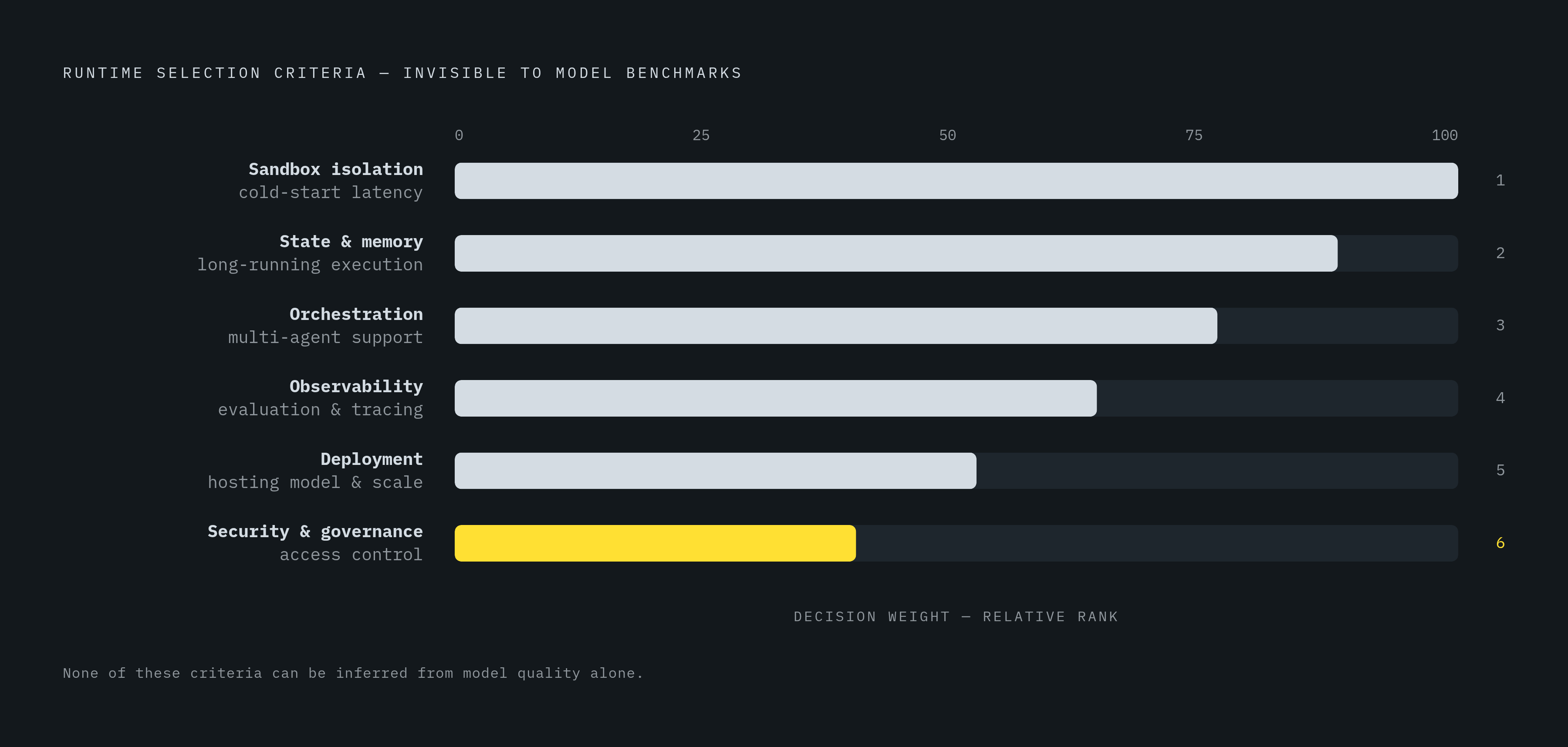
Six criteria make those choices comparable. They are sandbox isolation and cold-start latency, state and memory for long-running execution, orchestration and multi-agent support, observability and evaluation, deployment and hosting model, and security and governance. None can be inferred from model quality alone. A production agent may hold state for hours or days, delegate to other agents, and scale from zero to heavy load, so ordinary cloud components do not automatically supply a purpose-built agent runtime.
Every production agent also has an identity, credentials, and data access. Isolation and secrets handling therefore belong in the initial decision. The same is true of governance. Once a runtime becomes the home for state, permissions, and orchestration, its boundaries also shape portability and the ability to control a growing agent estate.
The structural traps that architecture decisions create — vendor lock-in and agent sprawl
Vendor lock-in begins with what the architecture binds together. A platform tied to one LLM provider constrains future model choices, while model portability allows providers to change without rewriting business logic. Strong ecosystem fit can still be useful. Tightly integrated CRM-native agents favor that fit, whereas AWS Bedrock’s multi-model flexibility illustrates a different priority. Neither characteristic alone settles the purchase.
Integration depth creates a second portability test. Genuine MCP support lets connected enterprise systems function as callable capabilities without dependence on hard-coded connectors. The distinction is the maintenance burden. A platform can offer many integrations yet remain brittle when the underlying data infrastructure changes, so connector count is not a substitute for examining how access works.
Agent sprawl follows a related architectural choice. Enterprises may combine pre-built agents for common tasks, low-code platforms for custom workflows, and OSS frameworks for differentiated builds. Variety is not itself the failure. Without a shared control plane for identity, memory, and observability, however, that mixture becomes difficult to govern as non-deterministic behavior spreads across systems.
Gartner estimates 40% of agentic AI projects face cancellation by 2027 because of escalating costs, unclear business value, or inadequate risk controls. Those risks call for centralized governance when buying tools. Cost needs to be managed in the same control layer as security. Real-time budget controls and a master kill switch provide safeguards that a growing collection of disconnected agents does not supply on its own.
A practical evaluation scorecard for architecture-first procurement
The practical approach is to define five tests before comparing vendors. First, production track record should mean complex multi-agent orchestration in enterprise use. The evidence needs an immutable audit trail. Can the platform provide a complete record of each decision and action, and can the buyer inspect more than the final answer?
Second, governance should be enforced deterministically in infrastructure. Third, MCP depth should be judged by how well it offers native enterprise-system support and how much work it takes to maintain integrations. These are separate tests. A broad connector catalog does not establish policy enforcement, and a strong permission model does not establish maintainable data access.
Fourth, model portability should allow LLM providers to be swapped or combined without rewriting business logic. Fifth, cost observability should include real-time budget tracking, configurable alerts, and a master kill switch that halts agent activity instantly. Where does state live, and who can read it? What permissions does each agent need, and how can a reviewer see what it did and why?
The final fit test matches execution to the pattern. Code-executing agents need microVM sandboxes, long-running autonomous work needs durable execution, and strict enterprise governance points toward managed hyperscaler runtimes. For a small business without a technical team, the assembly burden is also part of that decision. A purpose-built agent operating system brings runtime, memory, identity, orchestration, and observability together without requiring separate infrastructure work. Its value rests on meeting the scorecard.