Business AI Platforms Compared for Enterprise Deployment
How to evaluate enterprise AI platforms on execution, not just retrieval.
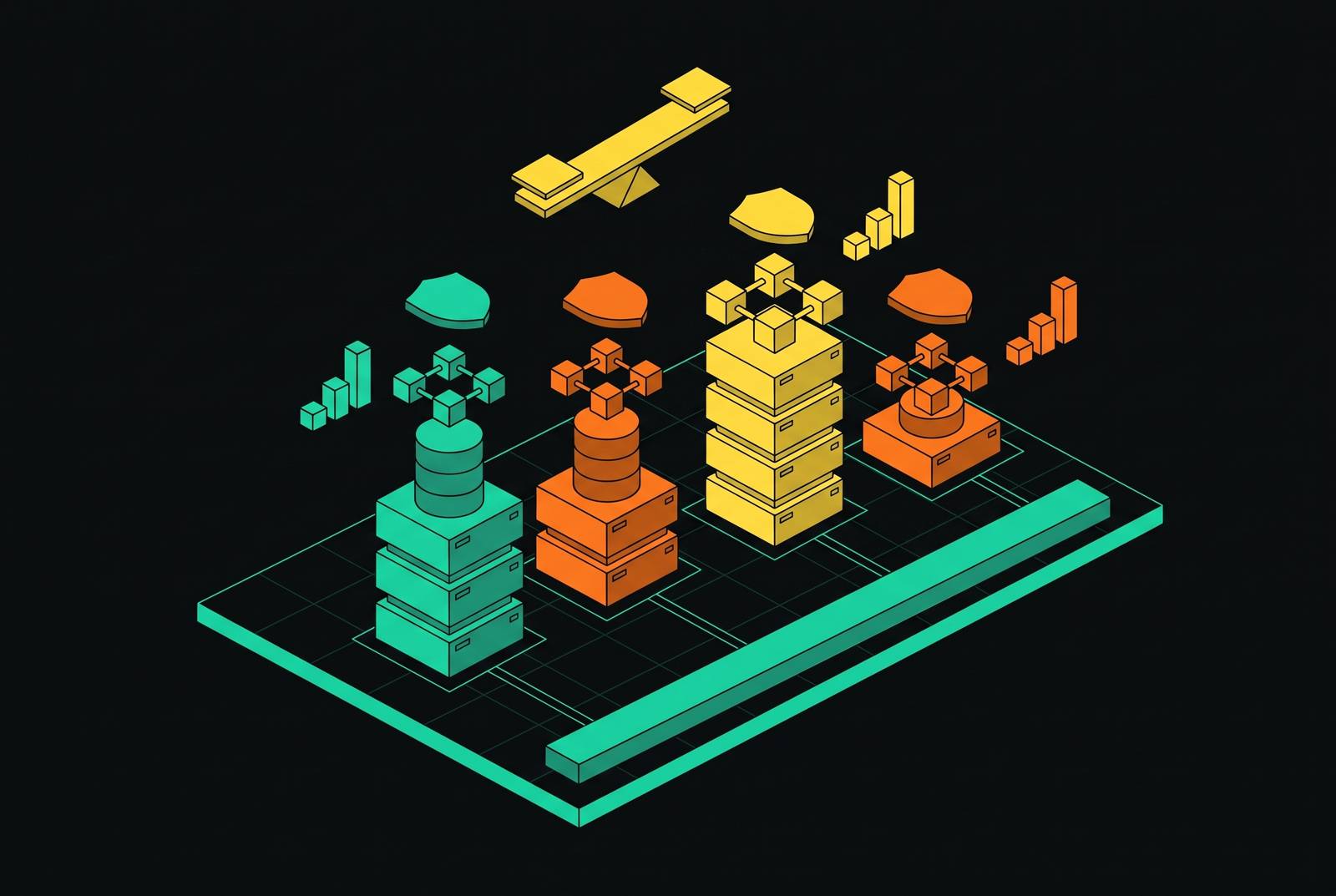
The choice of a business AI platform should rest on whether it has three capabilities, persistent context, autonomous write-back, and a runtime built for agent workloads. Most platforms sold as enterprise agents are retrieval systems with agent branding, so buyers must compare how they answer questions and how they complete work. Packaged tools suit bounded tasks, ecosystem platforms suit an existing software estate, and developer-first infrastructure suits teams that need control across systems.
Why most "enterprise AI agent" platforms are retrieval systems in disguise
The buying vocabulary has outrun the product reality. “Agentic” now describes chatbot wrappers, rebranded automation tools, and copilot layers, even when their central function remains finding and presenting information. A platform can search a knowledge base, summarize a document, and draft a response without resolving the underlying request. Those are useful functions, but they do not establish agency.
Does the system complete the work, or does it leave a person to make the change and track what happens next? This distinction separates retrieval from execution without dismissing retrieval as a legitimate purchase. It also explains why a polished demonstration is not enough evidence for an automation decision.
The three runtime capabilities that define genuine agency
Persistent context lets an agent keep task state across sessions, track approvals, and pick up work where it left off. Recall alone is not enough for this. Atlan’s context management guide distinguishes memory of past conversations from long-term context governing which business definitions, policies, and data sources are trusted now. Transient context, durable run state, checkpoints, and long-term memory thus each need to be handled on their own.
Autonomous write-back means changing connected systems. An agent might open a ticket, provision access, update a record, or complete an approval chain without requiring human intervention at every step. Routing is not the same as resolving.
A purpose-built runtime provides guarantees for adaptive workloads whose actions are generated as they run. Laurent Bindschaedler’s keynote at AgenticOS @ SOSP 2026 frames the gap as a missing “POSIX for agents,” with contracts for effect, state, composition, and intent. Hosting alone cannot provide those agent-level guarantees. Without runtime contracts around idempotency, intent, and irreversibility, the application developer inherits the burden of controlling actions that the model generates.
What a production agent stack actually looks like in 2026
A production platform is a stack. Foundation models are almost always bought, while orchestration logic is built on purchased frameworks. Memory infrastructure can be bought while retrieval logic is built, and purchased guardrails still need domain customization. Beneath those choices sits the runtime on which the layers depend.
The model layer also need not mean one model. Production agents commonly route classification to small, quick models, hard reasoning to frontier models, and embedding and evaluation to dedicated models.
Memory introduces another set of architectural choices. Persistence can range from none to session-only state, file-backed storage, or structured database- or vector-backed retrieval, and production harnesses often use hybrid approaches. The presence of a memory component does not, by itself, establish durable workflow state. Buyers need to keep that distinction in mind when platforms use the same words in their feature lists for different layers.
The three buying paths and what each one trades away
Vendor-packaged agents are the fastest way to get started with defined, bounded use cases. Sierra, Decagon, Salesforce Agentforce, and Ada belong on that shortlist. The trade-off is ownership and extensibility, especially when work expands beyond the original scope or requires cross-system execution the vendor did not anticipate. Speed is a legitimate reason to buy. For a small business without a technical team, that trade-off can be more practical than assuming responsibility for an agent runtime.
Ecosystem-centered platforms fit organizations whose work is already in an enterprise software estate. They inherit its data model, governance, and integrations, which can speed adoption inside that environment. The constraint appears at the boundary. Even when native capabilities are strong, external execution depends on the integration route. These categories can overlap, as Agentforce illustrates.
Developer-first platforms and purpose-built runtimes exchange that convenience for control over orchestration, memory, deployment, and model choice. Self-hosted or VPC deployment and an LLM-agnostic runtime become part of the buying decision. The engineering commitment is substantially larger, however. This path fits teams that build agentic software instead of using a packaged solution, while it may be more than an organization needs to get more work done.
How the ecosystem-locked platforms compare on the three runtime criteria
Microsoft Copilot Studio belongs in the ecosystem-centered comparison, but the supplied material does not establish its persistent context, autonomous write-back, or runtime contracts. A shortlist cannot responsibly turn an unverified capability into either a pass or a rejection.
Salesforce Agentforce has a clearer fit in CRM, service, sales, and Salesforce-centered work. It grounds agents in Salesforce data and metadata and executes within that environment, with cross-system reach dependent on MuleSoft configuration. Its execution scope is clearer than the supplied evidence for persistent task state, durable context, or purpose-built runtime guarantees.
Google Cloud Vertex AI Agent Builder has visual and code-based paths, memory, a managed runtime, and cloud services for GCP-centered work. Memory support is a relevant signal, but session recovery and autonomous write-back still need demonstration. Its managed runtime leaves agent contracts unverified, along with governance questions concerning registry, identity, data grounding, evaluation, and control of third-party agents, none of which the available material settles end to end.
Amazon Bedrock AgentCore exposes composable runtime, memory, gateway, identity, policy, observability, and evaluation services. Yet component availability does not prove autonomous completion or end-to-end guarantees. Which services the team must configure and how policy holds across them remain unresolved.
ServiceNow AI Agents fit workflows centered on the platform and its enterprise process data, with credible production evidence in IT and ITSM-heavy enterprises. Its governance architecture is a strength within that estate. The remaining questions concern how native and external agents are discovered, authorized, monitored, and optimized. The supplied evidence does not separately establish persistent task context, unattended write-back depth, or the runtime contracts defined above.
IBM watsonx Orchestrate covers native and external agents, tools, models, a catalog, and a management layer. Its scope extends beyond a single assistant interface. Even so, that breadth does not establish durable context or autonomous write-back for a particular workflow. Buyers still need evidence of how policy, lifecycle, cost, and observability extend across connected environments, including what the runtime itself enforces.
UiPath fits end-to-end processes combining agents, robots, APIs, legacy systems, and human decisions. That puts execution, rather than retrieval alone, at the center of its proposition. Execution still needs boundaries and durable state. Its evaluation turns on agent autonomy, exceptions, audit, state, and third-party components, while the supplied material leaves the exact runtime guarantees unverified.
Cross-system and developer-first platforms for teams building beyond a single ecosystem
Rasa presents its developer platform as a way to build production-scale enterprise agents that work across voice and digital channels. Teams can mix guided and prompt-driven skills to bound agentic behavior in critical workflows. Control is central to that approach. Deployment model, integration depth, hallucination control, and multi-channel continuity are relevant evaluation dimensions, but continuity alone does not prove persistent task state or runtime-level action guarantees.
Console provides a concrete example of write-back. It handles password resets, software access provisioning, equipment requests, onboarding and offboarding, and license assignments through connections to the systems that fulfill those requests. It is designed to do a narrower range of work than open-ended assistance. The execution case is specific, while persistent context and purpose-built runtime contracts remain unestablished in the supplied evidence.
Aisera sits between retrieval and execution. It answers and deflects common questions and can trigger and orchestrate connected workflows, with execution depth dependent on integration configuration. Aisera’s omnichannel material names channels including Slack, Teams, email, and Webchat. Departmental breadth is its defining strength here. That breadth does not settle the separate questions of durable state and runtime guarantees.
Vellum emphasizes a personal assistant for enterprise operators, with persistent memory and native surfaces. Its evaluation, versioning, observability, and bi-directional syncing between visual interfaces and SDKs/APIs support development and oversight. For governance, it has role-based access controls, audit trails, and environment separation. Persistent memory is the clearest criterion supported here. The material does not establish autonomous write-back depth or runtime contracts, while it provides too little detail to assess another vendor on any of the three criteria.
Purpose-built agent operating systems address a different layer from these applications and builders. Their premise is that persistence, proactivity, and action guarantees belong in a developer-controlled runtime. That is an architectural requirement. For teams building their own systems, deployment flexibility and control only become durable advantages when the substrate enforces the required contracts.
Memory architecture as the sharpest dividing line between platforms
Memory is best assessed by what the platform remembers, at what scope, and for how long that information remains valid. A conversation history and an interrupted approval chain are different forms of state. Treating them as one feature obscures whether the agent can continue real work across sessions.
Mem0 uses a hybrid vector, graph, and KV approach across user, agent, application, and session/run scopes. Letta, formerly MemGPT, documents four memory tiers that agents manage through function calls. Zep/Graphiti uses a temporal knowledge graph with validity windows. Mem0 and Zep/Graphiti self-report strong benchmark performance, but recall performance does not establish complete workflow persistence.
Can the platform distinguish transient context from durable run state and checkpoints? Can it separate user, agent, application, and run scopes, while identifying which policies and data sources are currently trusted? The questions test different failure modes. A memory add-on cannot by itself enforce those distinctions throughout the runtime.
Operational cost and runtime efficiency as evaluation criteria buyers underweight
A convincing demo leaves production resource use largely untested. Agentic systems can make thousands of decisions and API calls per minute, so even costs that seem small for each one can add up quickly. Per-conversation or per-token pricing can become unpredictable as containment improves and agents complete more work themselves.
Context, memory, and tool calls contribute to the operating cost, as do limits on runs, users, and connectors. A pilot may not expose those constraints. The relevant comparison is the cost of sustained execution at the intended scale.
Unresolved coordination creates a separate resource problem. When agents consume resources without resolving their shared work, application-level controls do not supply fleet-level resource contracts. The runtime must enforce those contracts across the system. This makes runtime efficiency part of platform selection, rather than a tuning exercise postponed until after deployment.
How should a company evaluate business AI platforms for deployment?
A practical evaluation begins by locating the organization in the three buying paths. A bounded use case and limited engineering capacity favor examining packaged options first, while workflows concentrated in an existing estate favor its ecosystem platform. Cross-system software development calls for a different ownership decision. The team must determine how much infrastructure it needs to control and can realistically operate.
Finalists should then face the same capability tests. Can an agent resume a multi-step task after a session ends, with state intact and side effects accounted for? Can it complete an approval chain, provision access, or update a connected record without intervention at every step? A successful answer is not sufficient evidence. The runtime test is whether idempotency, intent, and irreversibility are enforced beneath the application or delegated to its developer.
The next step is cost modeling at production scale, including agent counts, runtime hours, memory, context, tool calls, and operating limits. A manageable pilot bill is only a starting point. For teams building serious agentic software, the infrastructure decision should precede the orchestration framework. A purpose-built runtime is the architectural layer where persistent context and controlled execution must become enforceable contracts, rather than promises each application has to reconstruct.