AI Automation Tools for Business Operations Teams
Match your AI tool to what it actually finishes, not just what it promises.
AI automation tools for business operations should be chosen by what they can finish. Fixed rules suit trigger-response automation and RPA, while drafting and summarizing suit copilots. Work that requires lasting context, decisions under ambiguity, and action across systems needs an agentic platform with persistent state, tool access, and governance.
Why most AI automation deployments stall before finishing anything
An operations leader can have workflow automation flows, RPA scripts, and an AI assistant and still need people to close every loop. The assistant drafts a purchase order, but someone must submit it to the ERP, route approval, and track delivery. Investment at the “suggest and assist” layer leaves that responsibility with employees, even when the initial output looks complete.
Yet product labels often conceal this gap. Gartner distinguishes chatbots, simple agents, and advanced agents, warning that most products marketed as agents fall into the first two tiers. Gartner calls the relabeling of chatbots, RPA, and assistants without added autonomy “agent washing.” Can the system advance work without another prompt?
The capability spectrum: four distinct categories of AI automation, not one
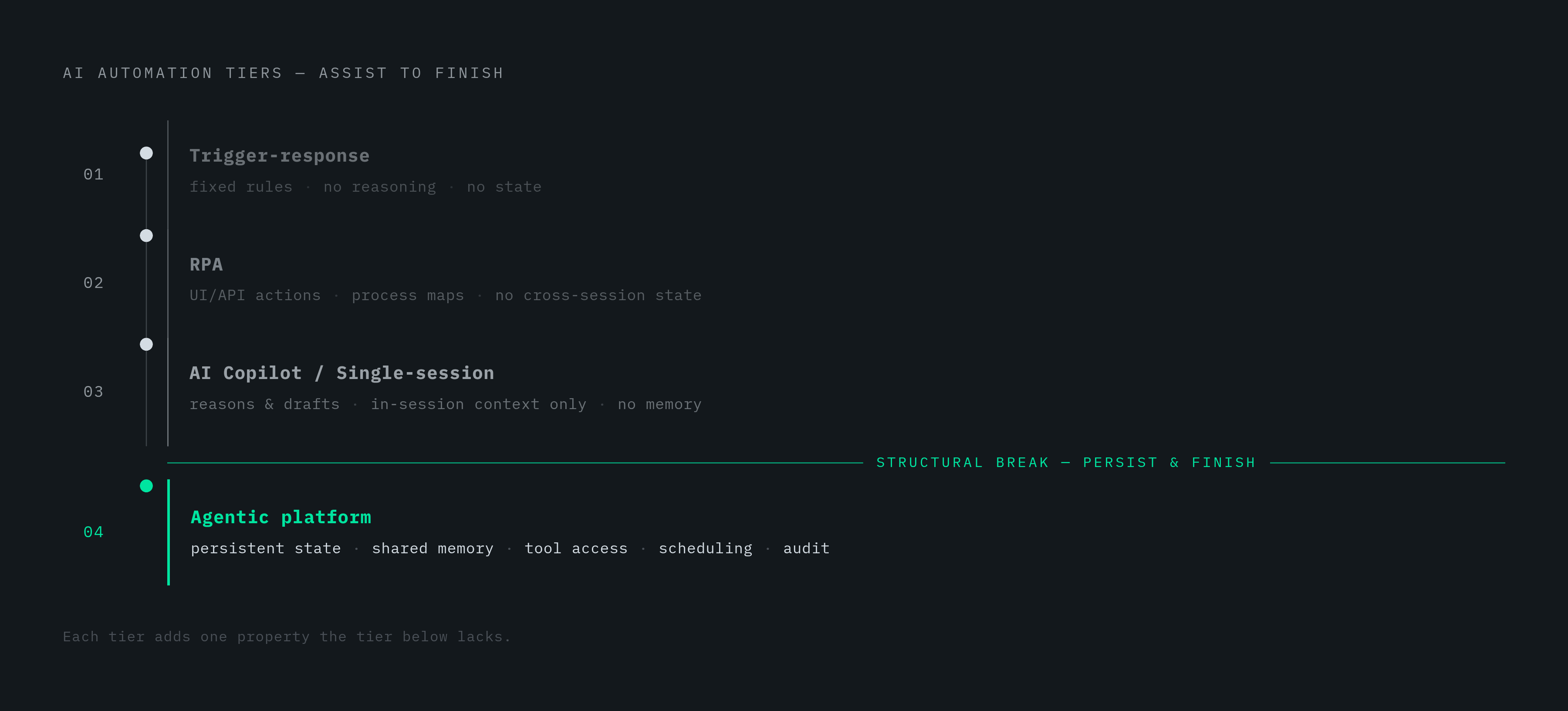
Category 1 is trigger-response automation, represented by app-integration workflows. If X happens, the system does Y, without reasoning, persistent state, or ambiguity handling. Predictability is the point of this category. It works when the rules are defined, but reaches its limits when exceptions fall outside those rules.
Category 2 is robotic process automation, or RPA. UiPath-class RPA automates repetitive actions across applications through their interfaces or APIs, following human-designed process maps. It does not supply cross-session state by itself. Changes to application surfaces can also cause silent failures, which makes the stability of the process part of the tool choice.
AI copilots and single-session agents are in Category 3. These assistants can reason, draft, and analyze within a conversation, but the category described here loses context when that session ends. The next task must come with fresh context. That is acceptable for a meeting summary, but insufficient for work whose next decision depends on earlier runs.
Category 4 adds persistent state, shared memory, tool access, decision logic, scheduling, and audit to coordinated agents. The defining difference is continuity across sessions and agents. When a workflow hits an exception, the architecture can keep it going through routing, escalation, and recovery. These categories are a map, and moving upward is justified only when the job requires a different structure.
What makes agentic systems structurally different: the six layers every credible platform runs on
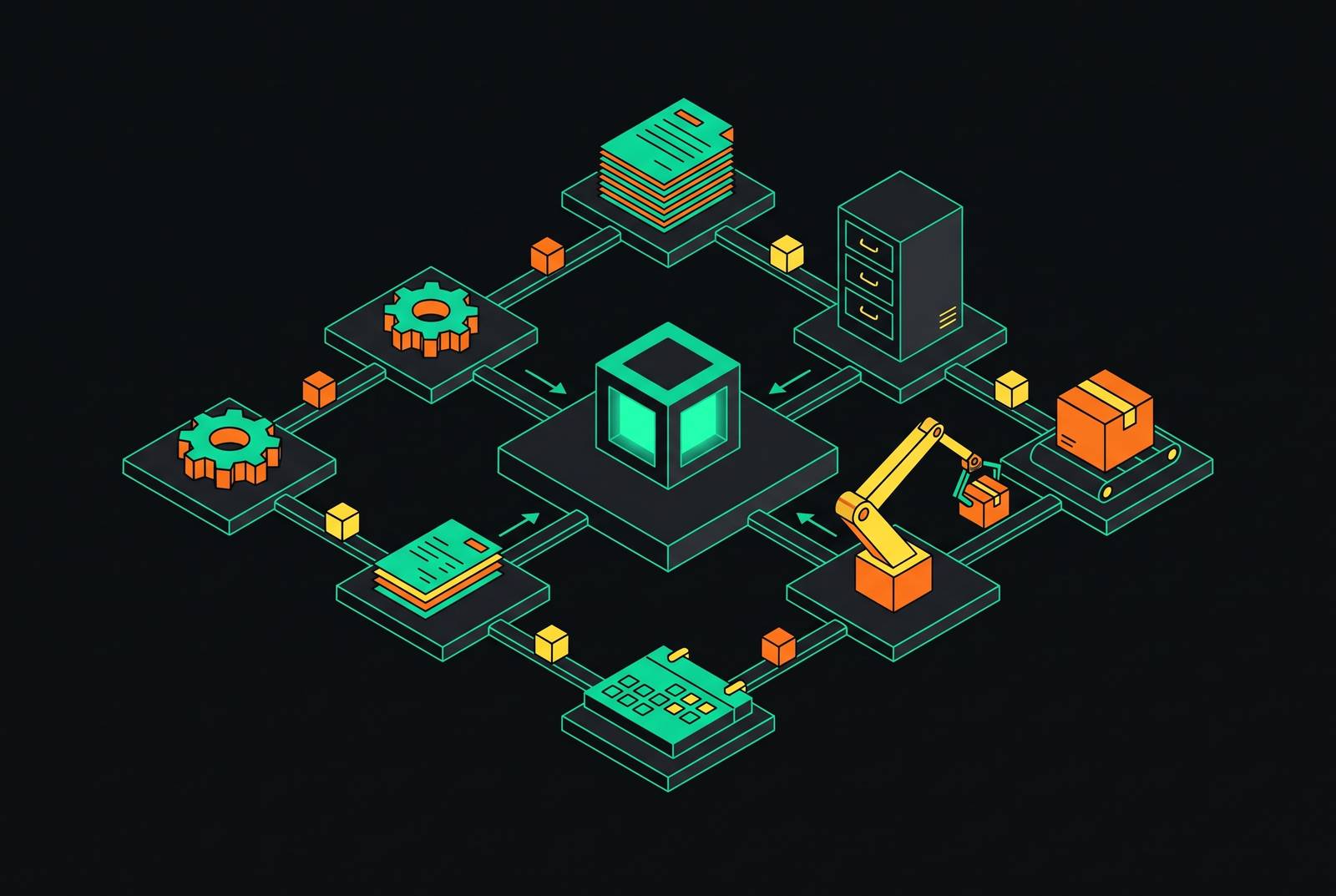
Make identifies six layers in an agentic operating architecture, namely connections and tool access, memory and shared context, agents, orchestration and routing, governance and audit, and observability and continuous improvement. Three questions make those layers easier to inspect. Where does state live, and who can read it? What permissions does each agent hold? How can an operator audit what the agent did and why?
Assessing state includes testing whether memory survives a conversation. MCP-backed memory servers can separate episodic histories from semantic facts and relationships, procedural workflows, and short-lived working memory. Those distinctions give stored context different roles. The agent layer then defines each agent’s identity, goal, toolset, and model, while orchestration determines when agents run and how their work is sequenced.
Assessing each agent’s permissions requires examining both connections and governance. Anthropic introduced Model Context Protocol, or MCP, in late 2024 as an open standard for connecting agents to external tools and data. A2A handles coordination between agents. Those connections give agents reach, while permissions, approval thresholds, and output validation set limits on how they can use it.
Assessing auditability tests observability through execution logs, cost monitoring, and drift detection. Scheduling also deserves scrutiny because polling, webhooks, and scheduled triggers enable work to advance without a person pressing a button. Tool access alone does not provide that continuity. At scale, enforcement matters just as much, since a permission boundary written into the agent’s instructions must also hold throughout a long run.
How to read the enterprise platform landscape without being misled by agent washing
The six-layer framework helps separate what a platform does from how it is described. A vendor may offer products in several capability categories, so one that started with RPA may have products outside Category 2. The reverse is just as true. An agent label gives no proof that a particular deployment has persistent memory, autonomous execution, or audit trails that can be used.
ServiceNow AI Agents sit within an enterprise workflow and governance platform. ServiceNow restructured its commercial model in April 2026 into Foundation, Advanced, and Prime, with AI Control Tower and Workflow Data Fabric bundled across all three. Prime is needed for fully autonomous AI agents for ITSM. Pricing is enterprise custom-quote only, so the commercial tier is part of the capability decision.
IBM watsonx Orchestrate gives teams one place to watch what agents do, coordinate work across enterprise systems, and apply governance policies. It can be used for requests from employees, customer service processes, and procurement operations. Orchestration and governance are its primary strengths. Organizations seeking autonomous departments still need to configure the agents and operating processes rather than expect a finished department from the platform alone.
UiPath combines RPA with AI agents, while UiPath Maestro coordinates software robots, agents, and employees through longer workflows. It fits complex back-office work with documents and repetitive data processing, though departments need more orchestration to work on their own. Workato focuses on cross-application integrations and agentic workflows. It fits teams connecting existing systems rather than building a new agent architecture, which is a different purchasing problem from selecting a centralized enterprise control layer.
What AI tools should a company use for each operational job?
Data transformation on a fixed schedule, document routing based on rules, and notifications triggered by forms belong in Categories 1 and 2. Zapier-class automation works well for trigger-response work, while RPA works well for repeated actions across application surfaces. The rules already determine the next step. Adding an LLM to these jobs adds cost without a capability gain when no interpretation is required.
Research synthesis, first drafts, meeting summaries, and one-shot analysis belong in Category 3. A copilot can finish the requested output when the context arrives fresh and the task ends with that output. No durable workflow memory is needed here. The distinction is between finishing a document and finishing the operational process that may follow it.
HR onboarding with regulated, cross-system decisions can require Category 4. An agent may need to verify identification documents, interpret localized regulatory requirements, check policy databases, generate compliance files, interface with payroll networks, and update ERP systems. Branching logic makes this a different job, with complexity arising from decisions between steps across regulated systems.
Software delivery offers another Category 4 pattern. A Supervisor-Worker arrangement assigns task decomposition to a planner, implementation to a code writer, review to an agent using a different model, and validation work to a test writer. Each agent can use the model that best fits its job. That division is useful only when tool contracts are sound, because a single agent with good contracts beats a multi-agent architecture with weak ones.
Where agents actually live: deployment surface and how it determines adoption
Portal-based deployment asks employees to remember a URL, authenticate, choose a category, and fill out a form. Each step creates an adoption burden. Chat-native deployment instead lets employees message an agent as they would a colleague, fitting work into an existing habit rather than requiring a sustained campaign to establish a new one.
Slack’s Agent Kit brings agents built on different platforms and frameworks into Slack through enhanced Bolt frameworks and CLI commands. Slack is also building thread and channel context management into the platform, reducing round-trip API calls to reconstruct conversation history. Other roles need other surfaces. SMS and iMessage serve employees who are not desk-based, while Composio offers 850+ pre-built toolkits spanning Gmail, Slack, GitHub, Jira, and Notion.
For engineering teams, a CLI-first runtime applies the same principle to existing pipelines and toolchains. The handoff must fit the surface too. A proper escalation creates a triaged record with category, priority, requester details, and information already collected, while keeping the employee in the same thread as a human takes over. Moving the employee into a new context discards the continuity that made the agent approachable.
Governance and security as capability constraints, not afterthoughts
Governance can feel like a limit on autonomy because it restricts what agents may do. In practice, enforceable boundaries make broader tool access and longer autonomous runs acceptable to the people approving them. Permission without enforcement is a fragile promise. Audit trails and per-action controls help procurement and legal teams approve work that would otherwise need a person to supervise it.
AgentKernel argues that application-level middleware falls short when it shares a process trust boundary with agents. Its proposed alternative is OS-level mandatory enforcement of identity, input mediation, memory governance, and execution control. This is an architectural proposal without a universal guarantee. Its argument is that trustworthy identity, controlled memory flows, and non-bypassable execution boundaries can support broader privileges while limiting unwanted actions.
AgenticRei identifies governance requirements beyond flat allow-or-deny decisions in engines such as XACML, Rego, and Cedar. These include obligations after an action, rules for resolving policy conflicts, exceptions that waive obligations, and reasoning over domain class hierarchies. Permission is only part of the policy. An agent allowed to perform an action may still be required to notify a compliance officer afterward.
The joint CISA/NSA advisory recommends evaluating policy per invocation. That places enforcement at the action boundary. Multi-agent systems also need policies to cover A2A messages, because controls on tool calls alone leave coordination outside the boundary. For platform selection, the practical distinction is between governance that describes acceptable behavior and governance that constrains each action and leaves an auditable record.
How to evaluate and sequence AI automation adoption without overbuilding
The adoption sequence should begin with the job. A deterministic process does not need an LLM, while a workflow requiring persistent context and cross-system execution will outgrow a single-session copilot. This also applies to small businesses without technical teams.
Before deployment, a team should establish the location and readership of state, each agent’s permissions, and the available action audit. Missing answers are a reason to pause. For teams building a custom runtime, the operating layer should enforce boundaries so that each agent’s logic does not have to recreate them.
The next step is one workflow validated to consistent value before expansion. Teams new to agentic systems can use an incident investigation with a set scope, a data reconciliation run, or an onboarding flow to try a Supervisor-Worker deployment without spreading their effort across many processes. Architecture alone is not evidence of value. Gartner forecasts that a significant share of agentic projects will be cancelled by end-2027, reinforcing the need to validate before broad deployment.
Deployment surface and governance belong in that first workflow. Chat-native access works well for non-technical operations staff and CLI-first access for engineering teams, and both should have permission boundaries and audit traces from the start. Retrofitting them is substantially more costly than designing them in. The goal is finished work, which may mean keeping most workflows in Category 1 and reserving Category 4 for jobs whose complexity genuinely requires it.