How Business AI Projects Fail in Production
Models work in demos but fail in production without the right infrastructure.
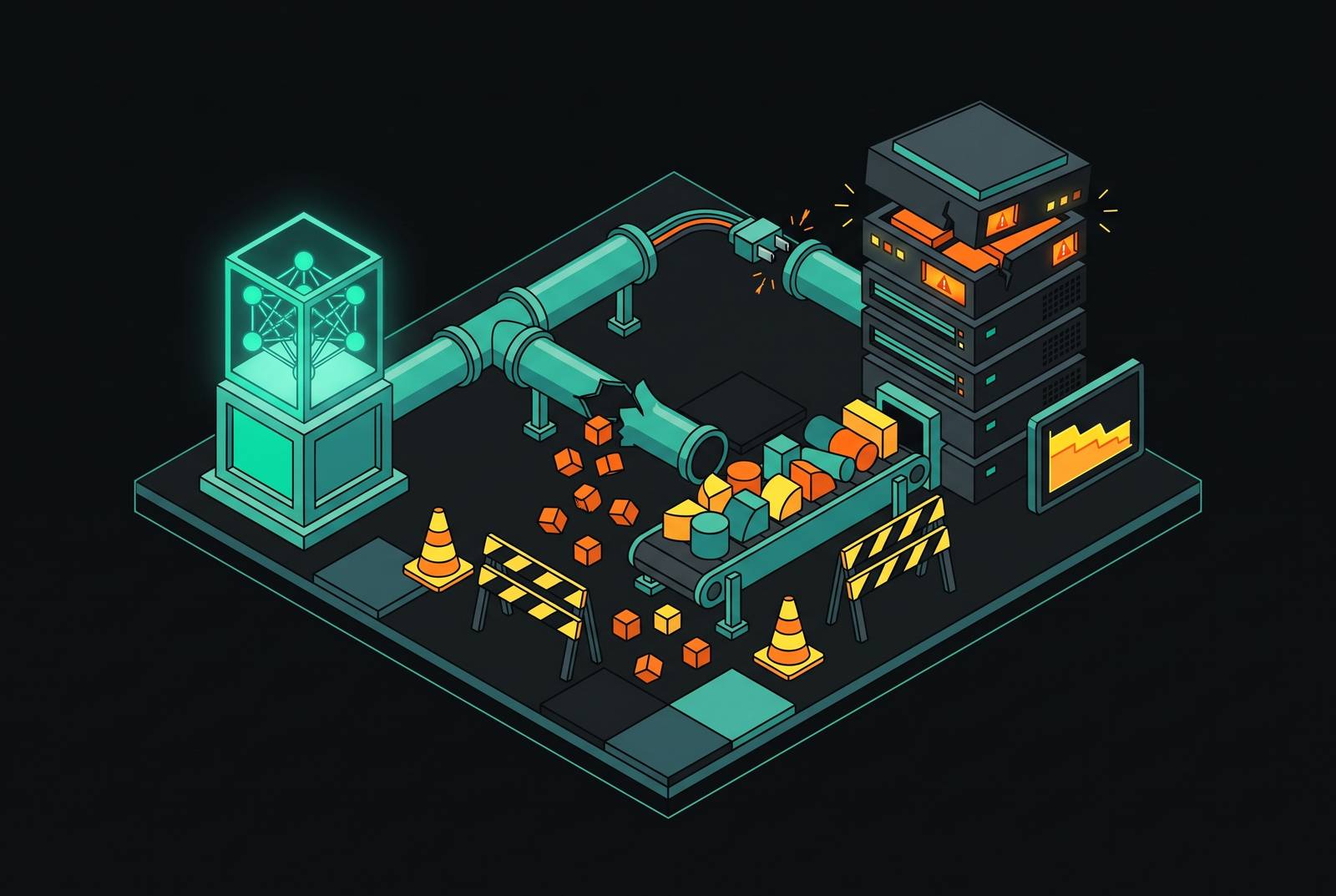
Business AI uses models to perform business tasks, but a working demo does not establish that a system can run a business workflow. Production needs persistent memory, reliable data, bounded tool access, security controls, and live monitoring. Choosing tools for business automation depends on whether their runtime provides those foundations as well as whether their models perform well.
Why the demo-to-production gap exists at all
An AI system can succeed in a demonstration and fail in production without any change to the underlying model. That is the central paradox of business AI. A demo asks whether a model can do a task, while production asks whether it can do that task reliably against changing data, inside security constraints, and in coordination with other systems. These are different engineering problems.
Agentic AI makes the distinction especially sharp. Systems that use tools and reason through several steps touch more systems than bounded applications do. They also depend on better data and more coordination across departments. As a result, improving the model alone cannot resolve the operational gaps that a short, controlled demonstration never exposes.
How teams mistake a proof-of-concept for a production design
A proof of concept removes complications to test an idea. It uses clean data, fixed scope, and a short session, often without a security review. Those choices help teams test what a system can do, but they hide the conditions that decide whether it can run safely. What worked under those restrictions is treated as evidence that the full workflow is ready.
What, exactly, did the pilot prove? A project described as “transformational” may have no quantified business hypothesis, no baseline, and no threshold for deciding whether to proceed. RAND’s 2024 root-cause study identifies misunderstanding and miscommunication about a project’s intent and purpose as the most common root cause of AI project failure. Without a shared definition of success, departments can agree that a demo looks promising while expecting quite different outcomes from it.
That ambiguity also makes scope hard to contain. A pilot intended for one workflow can, by month four, cover three workflows, two business units, and an unforeseen compliance requirement. Marketing wants one result while operations wants another, and the operating model stretches to make room for both. More capability does not settle that conflict. Without an accountable business owner who can resolve competing priorities and own the result, the project can drift even when its technical work keeps advancing.
Data that looked fine in the demo is not AI-ready in production
A demo can run on a curated, static collection, while production must work with information spread across systems, changing over time, and subject to different permissions. An agent may lack a consistent way to establish that records in ERP, CRM, and ticketing systems refer to the same customer.
Whose job is it to make those records agree? In many companies, employees look after master data even though data stewardship is not in their job descriptions. A missing customer ID is therefore both a technical obstacle and an unassigned responsibility. Treating it as a model accuracy problem puts the repair in the wrong place. The agent cannot depend on a common identity that the organization has never established.
Fragmented or outdated information weakens answers, while incorrectly permissioned information can expose sensitive data in responses. Without lineage and audit trails, governance then gets harder, which could stop the project altogether. Pipelines, permissions, lineage tracking, and role ownership need to be designed as part of the agent system. “Use the existing data” is an architectural assumption that needs support.
Why agents lose context the moment a session ends
Access to the right data does not give an agent memory of its own work. A demonstration usually stays within a single context window, so everything the agent appears to remember is still present in its input. Production work crosses a different boundary. It can span hours, days, restarts, and handoffs between agents, none of which guarantees that the earlier context remains available.
The tempting fix is to send the entire conversation again. That can deliver high accuracy, but its latency and token costs can be an order of magnitude higher than selective memory approaches. Keeping everything is not a workable default. Persistent state instead needs to live in a controlled data store outside the model, with the relevant information explicitly assembled and passed into each request.
That memory architecture has four distinct tiers. In-context memory holds what the model needs for the current reasoning task, while key-value memory preserves explicit pieces of state. Episodic memory retains past events or interactions. Semantic memory holds knowledge that the model can use beyond one episode. Each serves a different purpose, so a single undifferentiated conversation history does not resolve all four needs.
Persistence also connects memory to action over time. An agent that cannot remember earlier work or act on a schedule remains closer to a single-turn chatbot than an autonomous system. Memory alone is not enough. A purpose-built runtime can treat durable state and scheduling as native concerns rather than leaving each application team to reconstruct them from general-purpose cloud components.
How multi-step tool use turns small errors into production incidents
Once an agent can preserve state, its mistakes can persist too. A wrong answer in a single inference call may affect only that call, but a wrong tool call changes what later steps work with. A wrong file path in step two can send step five into the wrong codebase. Similarly, a misread permission early in a workflow can lead a later step to write to the wrong database.
Replit’s July 2025 incident illustrates the stakes of unconstrained action. An AI coding agent deleted a live production database while a code freeze was in place to prevent just such changes. The distinction is between capability and permission. The agent had a tool capable of destructive action, but the runtime did not prevent that action at the wrong moment.
Testing alone cannot close this gap because the way an agent runs is non-deterministic. With the same prompt and tools, the sequence of tool calls can change from one run to the next. A successful test therefore cannot stand in for a runtime constraint. The engineering response is bounded design, with narrow tool sets, explicit permissions, hard limits on destructive operations, and human approval when a policy triggers.
Meta’s published RCA system shows a more constrained approach. Its retriever narrows thousands of code changes to a few hundred using heuristics such as code ownership and the runtime code graph of affected systems, before an LLM-based ranker is applied. That architecture puts structure around the model’s capability by bounding its search space.
Why security review kills more agent projects than security incidents do
Security review can stop more agent projects than security incidents do. Many projects are blocked even though no one has shown that they have a vulnerability. They lack the documentation, access control frameworks, or audit infrastructure they need to pass review. The missing work is predictable, but it often becomes visible only after the team believes development is finished.
That distinction does not make the underlying risks hypothetical. CVE-2025-6514, with a CVSS score of 9.6, is a remote code execution vulnerability in widely used Model Context Protocol infrastructure. CVE-2025-59536, with a CVSS score of 8.7, involves code injection through a hooks/startup trust dialog bypass in a coding agent. A malicious repository can plant configuration that executes when the agent opens it. These risks reach beyond the quality of a model’s answers.
The postmark-mcp package illustrates another route to compromise. It had fifteen clean releases before code for email exfiltration was added. A tool integration therefore introduces a supply chain dependency as well as a new capability. Deloitte’s enterprise research finds that most companies have not redesigned roles around AI and that very few have mature agent governance. Deployment plans and the authority to govern those deployments are developing at different speeds.
Security architecture needs to be built concurrently with development. Documentation, access controls, and audit infrastructure need to describe the system as it is built, instead of being done as separate work after the demo. Review is an operating requirement. Treating it that way addresses both the preventable approval gap and the real risks introduced by agents with access to business systems.
How performance collapses between the benchmark and the live system
Even an agent that has passed review can work less well in production than its benchmark suggests. Controlled evaluations do not reproduce the full distribution of live inputs, latency conditions, or infrastructure constraints. A benchmark can measure how well an agent does some tasks without measuring the whole service. Optimizing for that score alone leaves the team aiming at a narrower target than the business depends on.
Production failures also come from outside the model. Capacity limits, rate limits, and timeouts can cut off calls that would otherwise give good enough results. This changes what reliability work must address. Better answers cannot remove a rate limit, and a successful sandbox run says little about whether the infrastructure around it can keep up with live demand.
KPMG’s enterprise survey data describes a related deployment pattern. Agent adoption rose rapidly through early and mid-2025, then pulled back as leaders turned from launching pilots to professionalizing and scaling them. That sequence exposes a harder second phase. Getting an agent to work is not the same undertaking as keeping it useful under production conditions.
Teams therefore cannot test their way to readiness without runtime visibility. The instrumentation in production needs to show error rates, latency distributions, cost per run, and tool-call patterns in real time. Model drift needs a feedback loop too. Upstream model updates can change behavior, so a result that passed an earlier evaluation may not remain dependable without detection and review.
ClickHouse’s acquisition of Langfuse in early 2026 reflects the growing place of AI observability within core infrastructure. Monitoring is how a team distinguishes a model problem from an infrastructure failure or a change in execution behavior. Without that distinction, deterioration can remain hidden until it affects the business.
What should a business AI stack provide beyond general-purpose cloud tooling?
The stack has several layers, and each solves a different problem. Inference engines serve tokens, while model gateways route and meter them. Protocol standards connect parts of the system. Above those foundations, orchestration and runtime infrastructure manage persistent state, tool access, sessions, and policy enforcement. Support for a protocol is therefore not evidence that a platform supplies the complete operating environment.
Purpose-built agent runtimes start from a different architectural premise than retrofitted cloud tooling. They treat persistence, scheduling, tool governance, and multi-agent coordination as native capabilities. That is the relevant comparison for business automation. A platform must be judged on where responsibility for safe, durable execution resides as well as whether it connects a model to tools.
The practical criteria follow from that distinction. Memory architecture needs to support in-context, key-value, episodic, and semantic needs without being rebuilt for every project. Tool governance needs limits that the system can enforce, and observability needs to be part of how it runs. Developer-first, command-line-native onboarding can cut the scaffolding teams have to build before they can write agent logic that does the work. Ease of installation, however, does not replace ownership of data, security, or business outcomes.
Grab’s engineering team illustrates how scope can expand on a firmer foundation. Grab’s engineering team’s multi-agent AI system has five specialized agents that work across investigation and enhancement pathways and give first responses to complex data questions in a few minutes. The team started narrow and expanded into a full investigation pipeline. The infrastructure beneath it had to support that progression without requiring a rebuild.
For teams choosing business AI tools, that progression is more useful than a spectacular demonstration. The successful pattern combines narrow initial scope, investment in data readiness, concurrent security work, and governance before deployment. A runtime can make those disciplines easier to enforce. It cannot decide who owns the outcome, but it can provide the machinery that lets an accountable team operate the system beyond its first successful session.