Local Development Environments for LLM-Backed Agents
Open-weight models now make local inference viable for serious agent work.
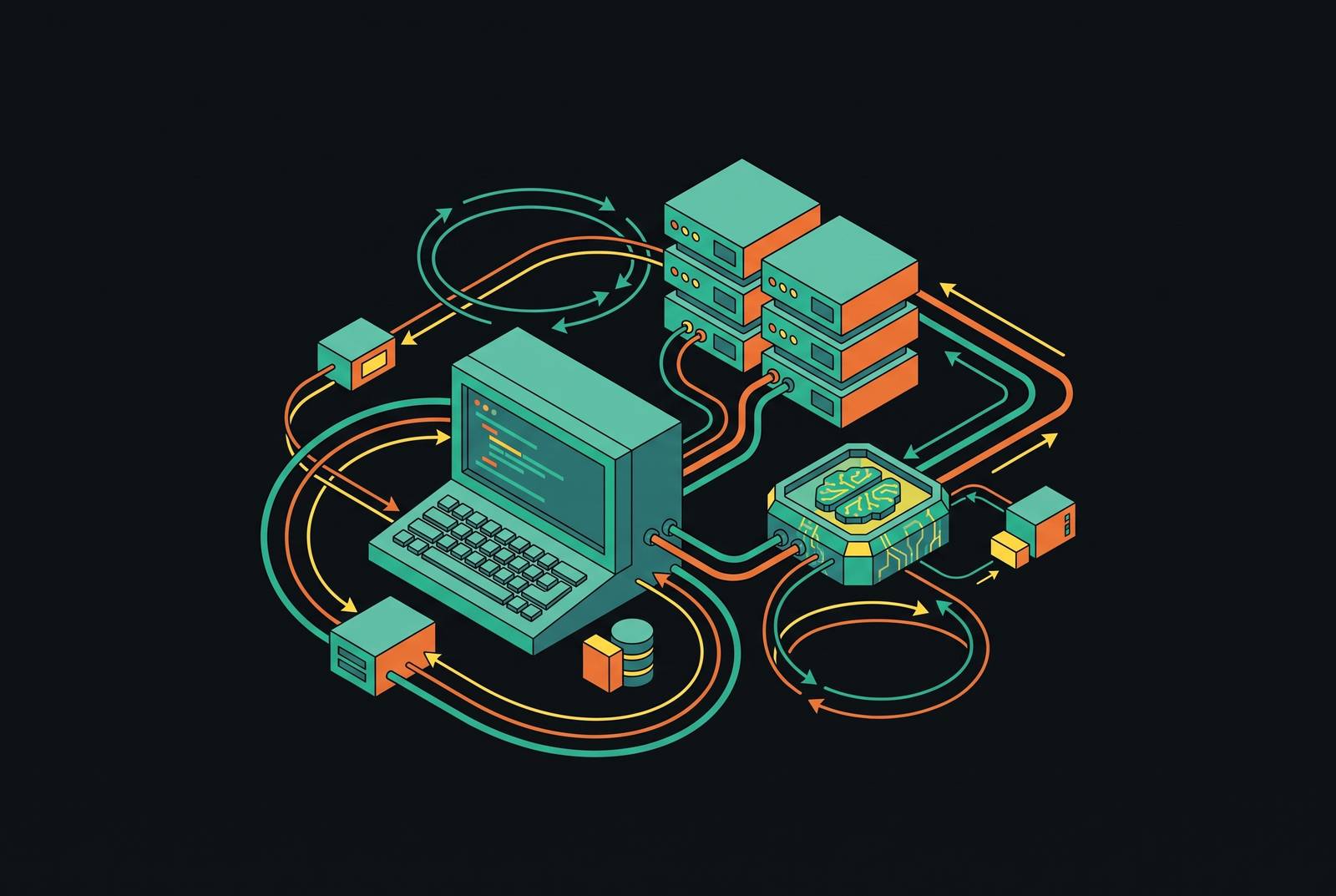
Local development for LLM-backed agents now means a layered stack, not a single tool: inference, tool connectivity, persistent memory, and the routing logic that ties them together. The reason that stack exists at all comes down to one shift in model quality, and that shift is where the argument starts.
Why local inference changed what a dev environment means
A year or two ago, running a serious agent meant calling a cloud API for nearly every step, because no model you could run on your own hardware was good enough to carry the work, but that has now changed. At the top of the open-weight field, GLM-5.3 scores 60 on the same quality index where Kimi K3 scores 57, and Claude Opus 5, a closed frontier model, scores 63. Three points separate the best open-weight option from the frontier. That gap used to be large enough to make local inference a toy. It no longer is.
What changes when the gap narrows to three points? Routing stops being forced and starts being a choice. Teams can now send most of their agent traffic to a model running on their own machines and save the cloud API for the calls that actually need it. That single shift turns a local dev environment from an API wrapper with a prompt box into something closer to a small distributed system, one that has to track which model handled which request and why. The inference layer becomes an ongoing coordination problem instead of a one-time setup step you install once and forget. Everything else in the stack sits on top of that problem, so it makes sense to look at the stack as a whole before going layer by layer.
The six layers a local agent stack has
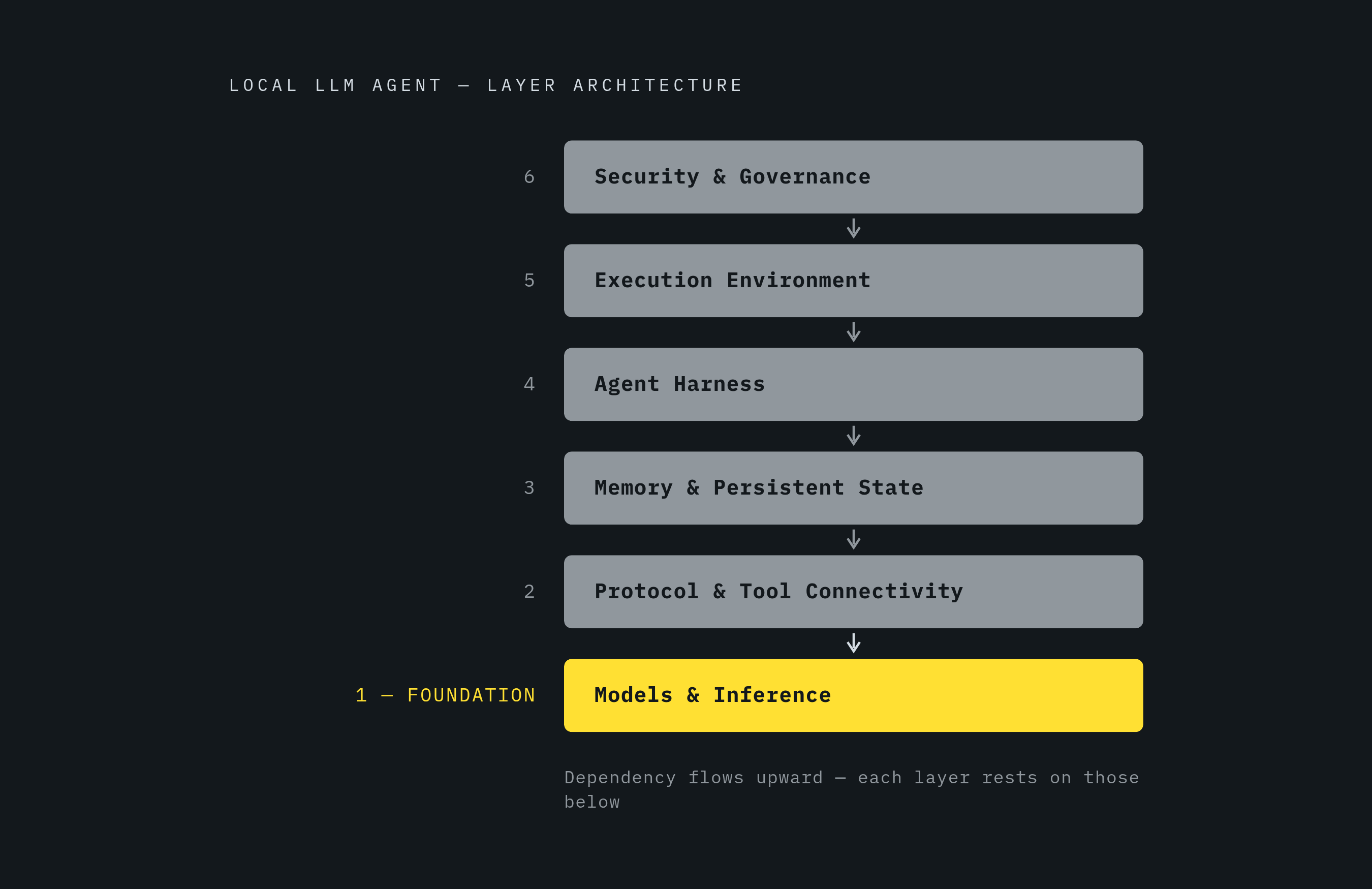
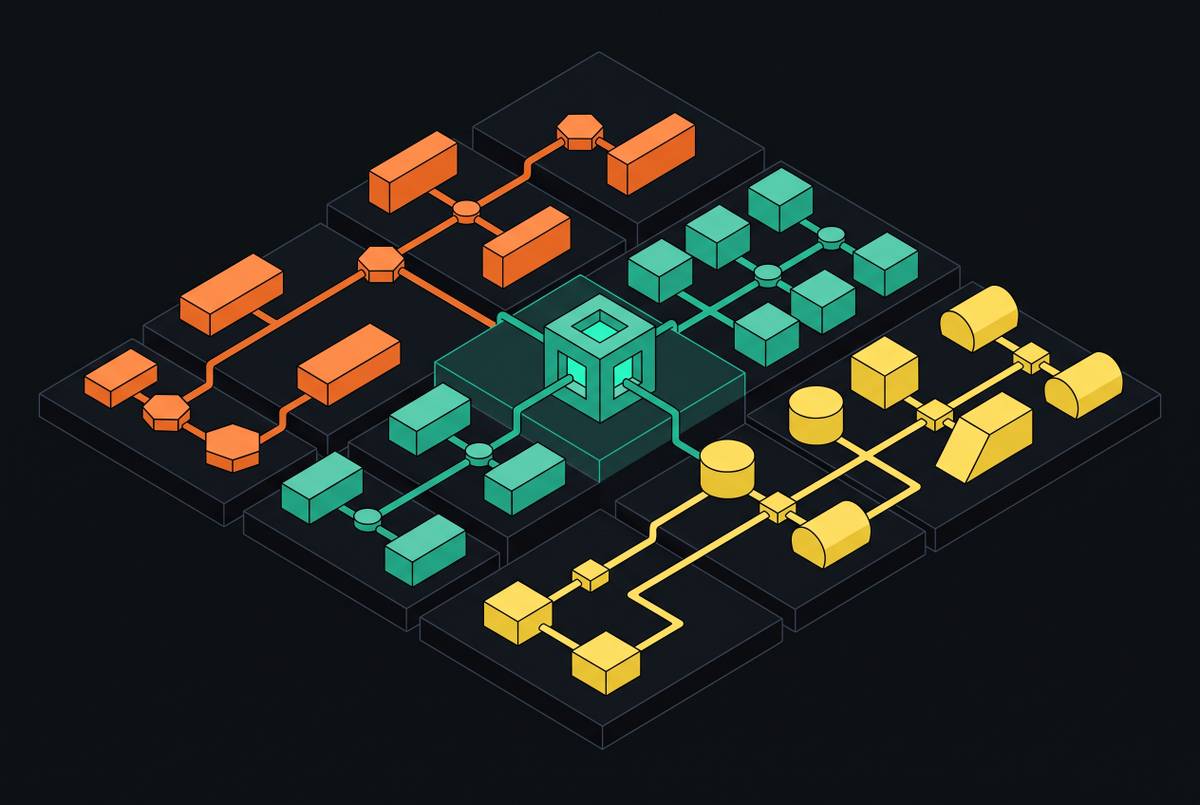
A local dev environment for agents breaks into six layers, and skipping any one of them tends to produce something that looks fine in a demo and falls apart under real use. The first layer is models and inference: the runtime that actually serves the model and exposes an API endpoint compatible with the OpenAI format, so the rest of the stack can talk to it the same way it would talk to a cloud provider. The second layer is protocol and tool connectivity, the standard that lets an agent find and call outside tools, and MCP has become the dominant protocol for this job. The third layer is memory and persistent state, the part of the system that lets an agent carry context across sessions and tasks instead of losing everything once a conversation ends. The fourth layer is the agent harness, the framework wrapped around the model that handles planning, keeps a registry of available tools, retries failed steps, and asks for approval before risky actions. The fifth layer is the execution environment, the sandboxed space where the agent's actual actions, code runs, shell commands, file edits, take place, kept separate from the developer's own machine. The sixth layer is security and governance: identity checks, isolation boundaries, audit logs, and rollback, the controls that make it safe to let an agent run without someone watching every step.
These layers depend on each other in one direction. A weak lower layer drags down everything built on top of it. A model that cannot produce clean, well-formed tool calls makes the harness above it useless, no matter how well that harness is designed. A harness with no connection to a memory system makes persistence impossible, even if a perfectly good memory layer sits right there unused. The next four sections take these layers one at a time, starting from the bottom.
Choosing and running local inference: models, tools, and the hybrid routing decision
Before picking a model, the real decision is how to route requests between what runs locally and what goes to a cloud API. That routing decision, made first, determines which models and serving tools are worth setting up. The common pattern now: send the bulk of agent traffic to a model running on local hardware, and reserve a frontier API, something like Claude Opus 4.7, GPT-5.5, or Gemini 3.1 Pro, for the harder minority of calls that genuinely need it. Tools like Ollama and vLLM expose an API in the same format cloud providers use, so an agent harness can switch between a local model and a cloud model by changing a single line of configuration.
Three tools cover most of the local serving tier, and each fits a different team. Ollama is the easiest starting point: a single command downloads and serves a model, and its OpenAI-compatible API means swapping between local and cloud inference takes one line of code, not a rewrite. vLLM is built for production serving, making it the right pick once the local tier needs to handle several concurrent agent sessions at once. LM Studio gives desktop users a graphical option, useful for teams with engineers who would rather not manage Ollama from a terminal.
Model choice follows from the hardware available, not the other way around. For teams running a multi-node cluster, Qwen3.8-Max, a 2.4 trillion parameter model with a substantial share of active parameters, scores 58 on the quality index, and Kimi K3 scores 60, both representing close to the ceiling of what self-hosted open-weight models can currently do. Hardware planning has to account for more than the size of the model weights, too. At long context lengths, the memory used by the KV cache grows substantially, and sizing hardware around model size alone tends to undercount what a long-running agent session actually needs.
Banking, healthcare, and government organizations often operate under policies that keep customer data inside controlled, jurisdictionally approved infrastructure, whether that means on-premises servers or a government-authorized cloud. In those settings, a local inference tier is what makes AI adoption possible under the rules those teams already operate by.
MCP and the tool-connectivity layer: how agents reach external systems
An agent that can only talk isn't doing agent work yet. The most common reason a local agent can hold a fluent conversation but can't actually get anything done is a missing or half-built connection to the tools it needs: a database, a browser, the filesystem, some external API. For a long stretch, that connection had to be built by hand for each tool and wired separately into whatever harness the agent ran in. MCP changed that by giving the whole category a single server-client protocol, one way of connecting that works the same regardless of which tool sits on the other end.
Publishing an MCP server has become the standard way to expose a tool to an agent, replacing the custom integration work that used to be required for every single connection. In a local setup, this means something concrete and useful: a single agent session running in Cline or Continue.dev can reach well past the editor, using MCP servers for the filesystem, for a SQLite database, for a browser, and act across all of them without ever leaving the development machine. A coding assistant that edits one file at a time is limited; an agent that reads across sources, makes a decision, and acts on multiple systems within a single task is closer to a real agent.
A second protocol is starting to show up alongside MCP: A2A, short for agent-to-agent, which handles coordination between multiple agents. It matters once a local stack involves more than one agent playing a distinct role, which is increasingly common as these setups grow.
A fair question follows from all this: if an agent only needs to touch the local filesystem and run a shell command, does it really need MCP? For a single tool used in a single session, no, a direct integration is simpler and works fine. But the moment a task requires reading from a database, calling an external API, and writing a file, all within the same run, an MCP-based tool registry holds up better than a pile of one-off integrations. The stacks that hold together under real use are built this way.
Persistent state and memory: what separates an agent from an expensive chatbot
An agent that forgets everything the moment a session closes is a stateless function with a conversational interface, and calling it anything more generous overstates what it can do. Context windows are finite, so whatever lives only inside that window disappears once the window clears. An agent that depends entirely on in-context state can't build up knowledge over time, can't refer back to a decision it made last week, and can't stay on a task that spans more than one sitting.
Two architectural patterns handle this in local stacks today, and they solve the problem in genuinely different ways. The first, self-editing memory, used in Letta (formerly known as MemGPT), lets the agent decide for itself, through its own tool calls, what gets written, updated, or pulled back from memory. Memory blocks are labeled chunks of text pinned into context that the agent can edit directly, while a separate archival memory acts as a searchable database the agent queries when it needs something not already pinned. All of this persists in a database even after the information gets evicted from the active context window. The idea traces back to the MemGPT paper, "MemGPT: Towards LLMs as Operating Systems," which treated context management the way an operating system treats virtual memory.
The second pattern, used by Zep and built on its Graphiti engine, organizes memory as a temporal, entity-centric graph. Its strength is visible in multi-hop retrieval, following chains of relationships across time, which suits agents whose tasks depend on tracking how entities and their connections change over the course of a project. For teams that don't need a dedicated vector database at all, pgvector, an extension added to a regular Postgres database, handles embedding-based retrieval without introducing a new service into the stack.
The operating system comparison holds up well here. Just as an OS uses virtual memory to let a process address more space than the physical RAM actually provides, an agent memory system uses persistent storage to give the agent more usable context than the model's window alone allows. Without this layer in place, even a stack with strong inference and solid tool connectivity still can't handle the kind of work that depends on remembering what happened last session, and most meaningful work depends on exactly that.
Agent harnesses and execution environments: the loop that turns a model into a working agent
A model that can call tools correctly is not the same thing as an agent that reliably finishes a task. The harness is what closes that gap: the planning loop that breaks a goal into steps, the registry that tracks which tools are available, the retry logic that catches a failed step and tries again, and the approval gate that pauses before a risky action goes through. Strip any of these out and the model is still capable, but nothing around it is making sure that capability turns into a finished task.
Continue.dev's Agent mode is one reliable version of this pattern, giving a model the tools it needs to handle a broad range of coding tasks while keeping a human in the loop for approval on each step, all scoped to a single editor session. Continue.dev's design is not unique: other tools that hold up well in practice use the same scoped, single-approval-gate design.
The execution environment answers a different question: once the agent decides to act, where does that action actually happen? Code execution, shell commands, file edits, these need to run somewhere isolated from the developer's own machine, so a bug in the agent's plan or a bad tool call doesn't take down a real working environment. That sandboxing lets an agent run a multi-step task unattended instead of requiring approval for every single action. The harness decides what the agent does next; the execution environment decides where it's safe to actually do it. Both have to be in place before a local agent stack can be trusted with real work.